
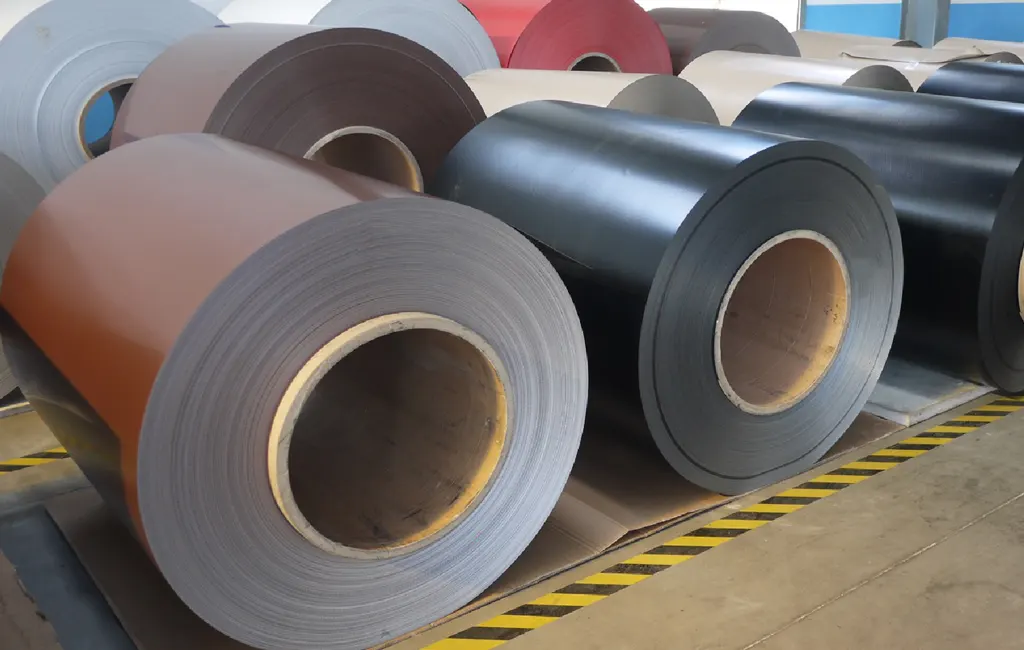

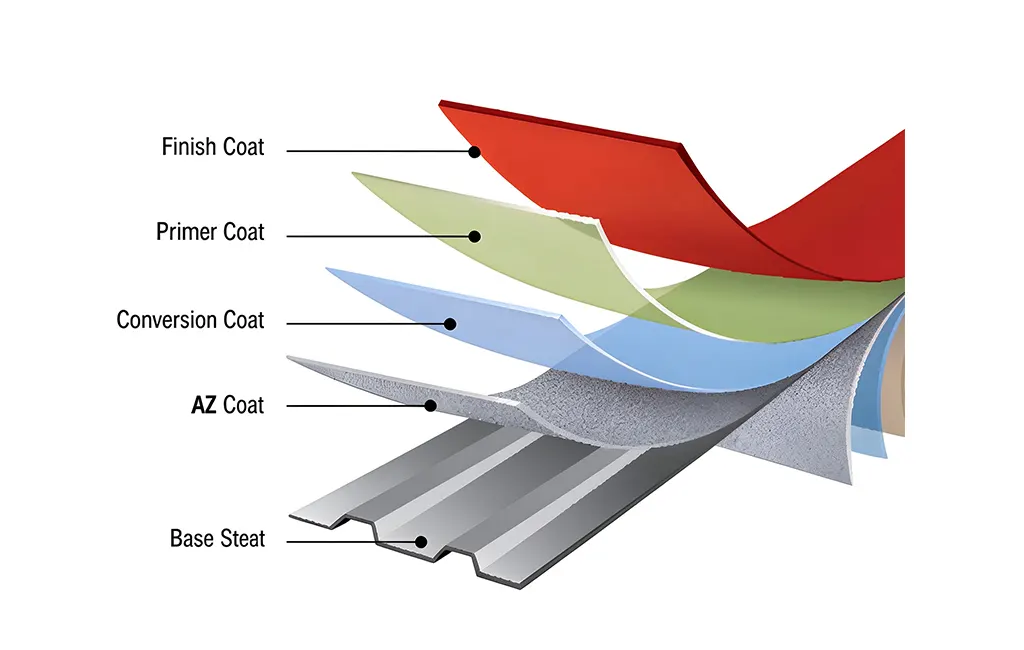
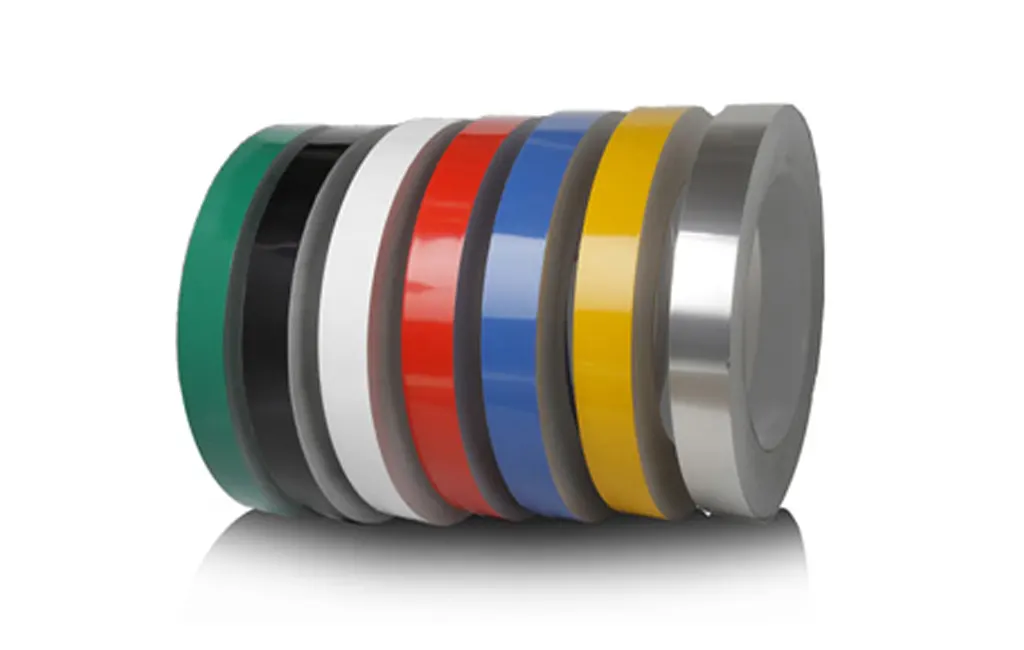
While color-coated aluminum and color-coated steel coils can look identical on a pallet—especially when covered in protective PE film—they have fundamentally different physical properties. If you need to tell them apart instantly on a factory floor or job site, here are the quickest, most reliable methods to differentiate them at a glance.
5 Quick Ways to Tell Them Apart
1. The Magnet Test (The Absolute Fastest Way)
The single most definitive “at-a-glance” test requires a small pocket magnet.
- Color-Coated Steel: The magnet will snap tightly to the coil face or edge (unless it is an incredibly rare austenitic stainless steel core, which is not standard for color coating).
- Color-Coated Aluminum: The magnet will not stick at all. Aluminum is completely non-magnetic.
2. Check the Exposed Cut Edges
Look closely at a raw, slit edge or a cross-section where the metal has been sheared.
- Color-Coated Steel: The core metal will look dark silver-gray. If the coil has been sitting in a humid warehouse, you may see a faint hint of reddish-brown iron rust forming along the unpainted cut edge.
- Color-Coated Aluminum: The core metal will look bright, clean, silver-white. It will never rust red; at most, it may form a dull, whitish oxide layer over a long period.
3. Gauge Thickness vs. Structural Rigidity
If you can touch an uncoiled sheet or sample piece:
- Color-Coated Steel: It feels noticeably stiffer and harder to flex. Standard roofing/cladding steel gauges are typically thinner (around 0.4 mm to 0.6 mm) yet remain highly rigid.
- Color-Coated Aluminum: It is much more pliable. To achieve the same structural rigidity as steel, color-coated aluminum is usually specified in thicker gauges (typically 0.7 mm to 1.2 mm). If a sheet feels relatively thick but flexes easily, it is aluminum.
4. Read the Coil ID Tag (The Professional Glance)
Every factory coil features a tracking label or ink-jet stencil printed on the inner sleeve or protective wrap. Look for these industry-standard material codes:
- Color-Coated Steel Tags: Will list steel grades like DX51D+Z, S250GD, CGCC (Commercial Galvanized Color Coated), or Galvalume / Aluzium (AZ).
- Color-Coated Aluminum Tags: Will list aluminum alloy series numbers, most commonly 3003, 3004, 5052, or 1100, often followed by a temper designation like H14 or H24.
5. Lift the Edge (The Weight Test)
If you try to hand-lift a small sample or sheet cut from the coil, the weight disparity is immediate.
- Color-Coated Steel: Feels heavy and dense. Steel has a density of approximately $7.85\text{ g/cm}^3$.
- Color-Coated Aluminum: Feels surprisingly light. Aluminum has a density of only $2.70\text{ g/cm}^3$—making it roughly one-third the weight of a steel sheet of the exact same dimensions.
