
Key Details for Preventing the Degradation of Colored Aluminum Coatings
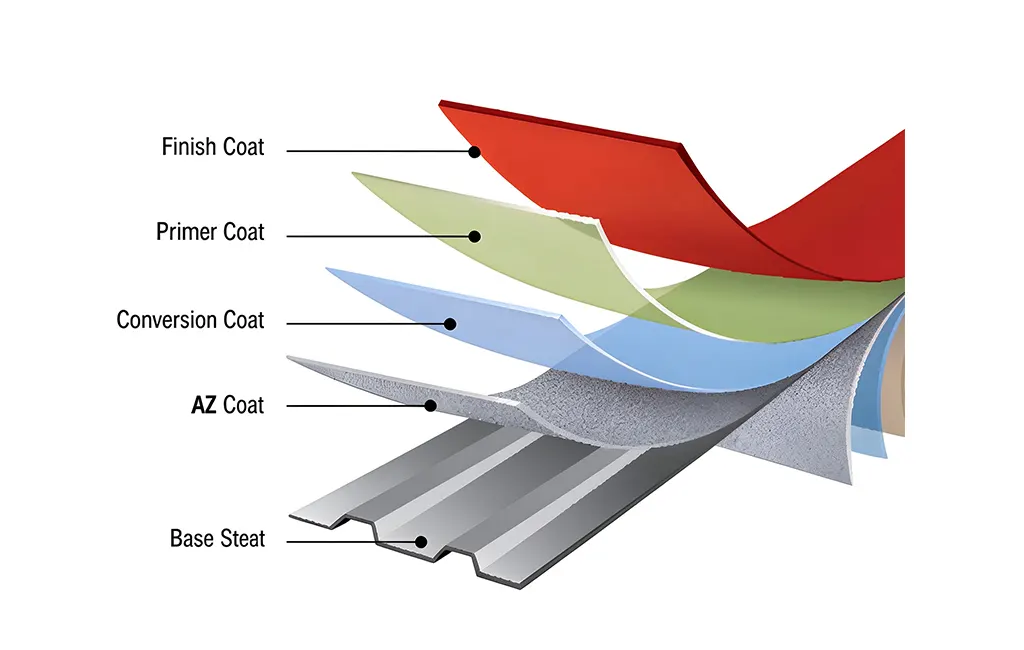
To prevent the degradation of colored aluminum coatings, engineering specifications must mandate a multi-layered protection strategy: a 70% Polyvinylidene Fluoride (PVDF) fluoropolymer topcoat with a minimum dry film thickness (DFT) of 25 μm complying with AAMA 2605-20, applied over a chemically converted substrate (chromate or chrome-free conversion coating). Degradation is primarily driven by photo-oxidation from UV radiation and hydrolytic cleavage from environmental moisture. Selecting manganese-stabilized aluminum alloys like AA3005 or AA3105 ensures mechanical compatibility and minimizes micro-cracking during roll-forming, while maintaining a color fastness profile of Delta E ≤ 5.0 after 3,000 hours of accelerated weathering testing.

Technical Parameter Matrix: Coating Durability & Substrate Performance
The following structural data matrix contrasts the performance metrics of primary organic coatings applied to architectural and industrial aluminum substrates.
| Technical Parameter | PVDF Fluoropolymer Coating | High-Durability Polyester (HDP) | Super-Durable Powder Coating |
| Compatible Alloy Grades | AA3003, AA3005, AA5052 | AA1100, AA3003, AA3105 | AA5052, AA6061, AA6063 |
| Pre-treatment Standard | DIN EN 12487 (Chromating / Alternative) | ISO 10546 | Qualicoat / GSB Requirements |
| Total Coating Thickness (DFT) | ≥ 25 μm (Base + Top) | 18–22 μm | 60–80 μm (Single layer) |
| UV Resistance Class (EN 10169) | RUV4 (Highest stability) | RUV3 | RUV3 to RUV4 |
| Salt Spray Resistance (ASTM B117) | ≥ 3,000 Hours | ≥ 1,500 Hours | ≥ 2,000 Hours |
| Gloss Retention (ASTM D523) | ≥ 80% after 10 years FL exposure | ≥ 60% after 5 years FL exposure | ≥ 70% after 5 years FL exposure |
| Color Fastness ($\Delta E$ CIELAB) | ≤ 5.0 (10-year South Florida) | ≤ 8.0 (5-year South Florida) | ≤ 5.0 (5-year South Florida) |
| Primary B2B Applications | Commercial Curtain Walls, Roofing | Residential Gutters, Roller Shutters | Structural Profiles, Window Frames |
Atomic Mechanisms of Organic Coating Degradation
Photo-Oxidative Resin Cleavage
Outdoor exposure subjects colored aluminum coatings to ultraviolet radiation (specifically UV-A and UV-B wavelengths). Under prolonged UV exposure, low-tier resins like standard polyester experience free-radical generation. These radicals attack the carbon-carbon bonds within the polymer backbone, causing chain scission.
The macro-result is chalking (ASTM D4214), a condition where the degraded polymer resin sheds away as a white powder, exposing unbonded pigments and reducing the material’s gloss. 70% PVDF coatings counter this via their inherent fluorocarbon chemistry; the fluorine-carbon (F-C) bond energy is approximately $485 \text{ kJ/mol}$, making it highly resistant to UV photon disruption.
Hydrolytic Penetration and Filiform Corrosion
In high-humidity or coastal zones, water molecules permeate through the organic topcoat via microscopic pore networks. If the pre-treatment conversion layer is defective or contaminated with chlorides, a differential aeration cell forms beneath the coating.
This initiates filiform corrosion—unstable, thread-like corrosion tracks that creep beneath the paint layer. This destructive process destroys the adhesive bond between the primer and the aluminum substrate, culminating in large-scale paint peeling and sheet blistering.

Industrial Application Controls for B2B Environments
Deflection and Environmental Management in Low-Slope Roofing
In industrial roofing and commercial curtain walls, low-slope zones are prone to water ponding. Standing water acts as a lens, concentrating solar radiation while building an acidic or alkaline solution from captured atmospheric particulates (SO2, NOx).
- The Fix: Architectural layouts must specify alloys with elevated yield strength (such as AA3004 or AA5052) to minimize mid-span deflection (< L/240). This prevents the formation of localized pooling basins that accelerate chemical degradation of the coating surface.
Thermal Expansion and Micro-Cracking
Aluminum possesses a high coefficient of linear thermal expansion (). When large-format colored aluminum panels face diurnal temperature swings of over 50°C, the metal substrate expands and contracts significantly.
- The Fix: The applied coating matrix must maintain matching flexibility. Using Thermoset Powder Coatings or High-Durability Polyesters (HDP) without proper plasticizers results in stress-induced micro-cracking along formed radiuses. These fractures become vectors for moisture entry, eventually leading to premature coating failure.