
Mechanics of Cracking in Embossed Aluminum Coil During Bending
Embossed aluminum coil will not crack under bending and forming if the alloy strain hardening, minimum bend radius (R/t ratio), and coating elasticity are correctly aligned with the embossing depth. Standard stucco or orange-peel embossing creates localized work hardening and micro-stress concentrations along the pattern crests. When cold-formed past the material’s yield point, micro-cracking occurs if the inner bend radius drops below 1.5t to 2.0t (where t is substrate thickness) or if high-temper alloys like 3003-H18 or 5052-H38 are used without sufficient elongation capability (≥8%). Utilizing flexible PVDF or polyurethane coatings with an elastic elongation matching the substrate prevents surface paint micro-fracturing during standard 2T to 3T bending tests per ASTM D4145.
Technical Parameter Comparison Matrix for Bending Embossed Aluminum
The table below outlines mechanical and coating performance boundaries for embossed aluminum coils across common alloys, tempers, and coating specifications under cold-bending conditions:
| Aluminum Alloy Grade | Temper Condition | Yield Strength (MPa) | Tensile Strength (MPa) | Min. Elongation (%) | Min. Bend Radius (R/t) | Recommended Coating System | ASTM D4145 T-Bend Rating | Cracking Risk Profile |
| 1100 | O / H14 | 35−105 | 75 – 120 | 12 – 25% | 0T−1T | PE / PVDF | 0T−1T | Negligible |
| 3003 | H14 / H24 | 110 – 140 | 140 – 180 | 8 – 14% | 1.0T−1.5T | Flexible PVDF / HDPE | 1T−2T | Low |
| 3004 / 3105 | H24 / H26 | 150 – 180 | 180 – 220 | 6 – 10% | 1.5T−2.0T | PVDF (2-Coat / 3-Coat) | 2T | Moderate |
| 5052 | O / H32 | 95 – 160 | 190 – 230 | 12 – 18% | 1.0T−1.5T | High-Durability Polyurethane / PVDF | 1T−2T | Low (Ideal for marine facades) |
| 5052 | H38 / H39 | > 240 | > 290 | 2 – 4% | >3.5T | Standard PE / Powder Coating | >4T | High (Severe metal/coating rupture) |
Key Drivers of Cracking in Embossed Color Aluminum Coils
1. Stress Concentration at Embossed Peaks and Valleys
Embossing processes (stucco, diamond, or woodgrain) mechanically deform flat aluminum sheet via engraved steel rolls. This creates non-uniform cross-sectional thickness and work-hardens the metal along the ridge peaks. During subsequent bending, tensile stress concentrates in these work-hardened local zones rather than distributing evenly across the sheet width, lowering the effective elongation limits.
2. Coating Flexibility and Glass Transition Temperature (Tg)
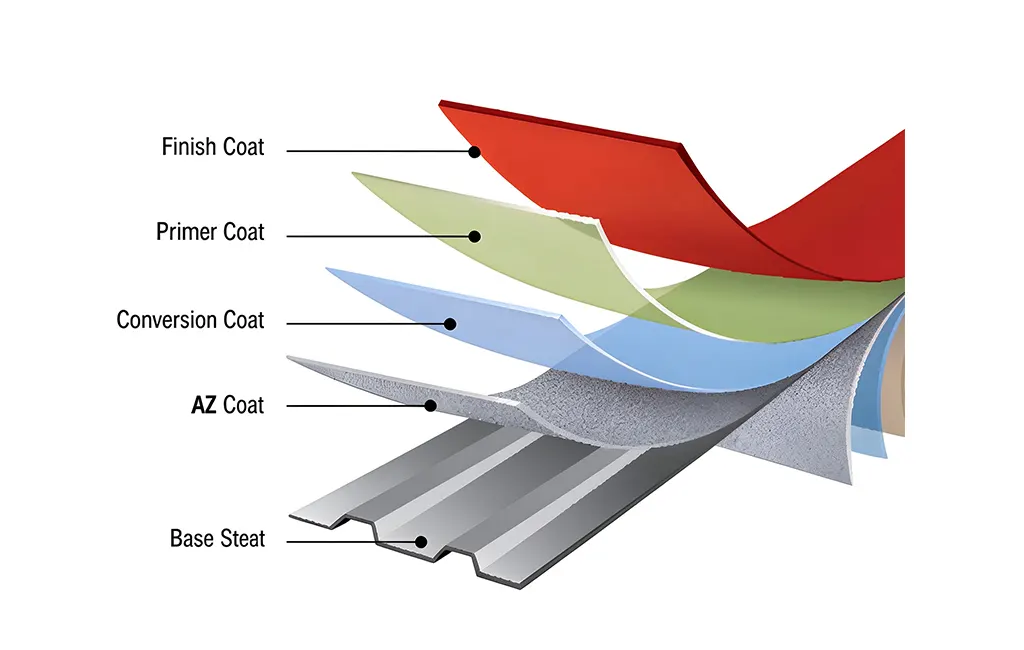
Pre-painted embossed coils feature organic primer and topcoat systems (e.g., PVDF, HDPE, SMP, or Polyester). Each coating system possesses a characteristic Glass Transition Temperature (Tg). When formed below its Tg, the coating matrix behaves like a brittle solid. High-performance exterior coatings complying with AAMA 2605 or ISO 12206 utilize plasticized fluoropolymer resins designed to remain flexible under dynamic mechanical stress.
3. Grain Orientation and Anisotropy
Aluminum alloys exhibit anisotropic mechanical properties resulting from cold rolling. Yield strength and elongation vary depending on whether bending occurs longitudinal or transverse to the rolling direction. Bending parallel to the grain alignment combines with embossed stress risers to significantly increase the probability of linear fracture along the bend line.