
Core Technical Applications of Embossed Aluminum Sheets
Embossed aluminum sheets (commonly known as stippled or orange-peel aluminum) are specialized rolled aluminum products featuring textured surfaces engineered through mechanical roller pressing. Manufactured primarily from 3000-series (Al-Mn) and 1000-series (Pure Al) alloys, these sheets combine structural rigidity, anti-reflective optical dispersion, and enhanced surface area. By increasing the effective surface area without adding weight, embossed aluminum optimizes thermal dissipation in HVAC heat exchangers, prevents optical glare in architectural facades, and enhances mechanical mechanical bonding for thermal insulation cladding. Compliant with ASTM B209 and EN 573-3 standards, they provide high strength-to-weight ratios and superior corrosion resistance across industrial environments.
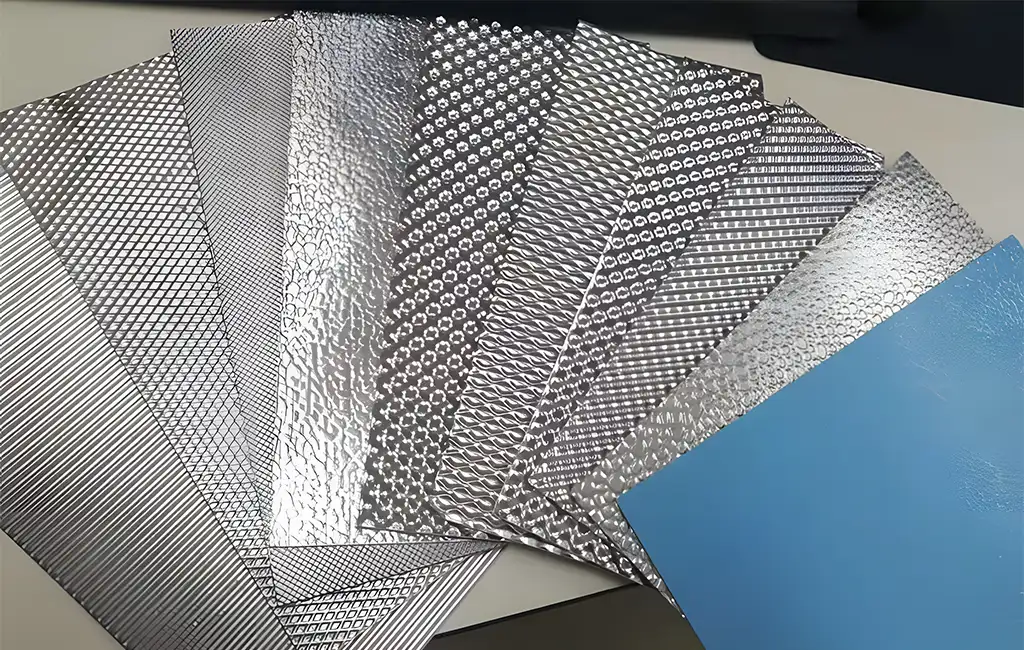
Technical Specifications & Performance Matrix
| Parameter | Construction Facades & Cladding | Ductwork & Thermal Insulation | Heat Exchangers & Refrigeration |
| Aluminum Alloy Grade | AA3003-H14 / AA5052-H32 | AA1060-O/H14 / AA3003-H14 | AA1100-O / AA3003-O |
| Pattern Types | Stucco, Classic Orange Peel, Diamond | Stucco, Hemispherical, Ripple | Micro-Stucco, Fine Orange Peel |
| Base Thickness Range | 0.8 mm – 3.0 mm | 0.2 mm – 0.8 mm | 0.3 mm – 1.0 mm |
| Coating Systems | PVDF (2-coat/3-coat, ≥25 μm) | Polyethylene (PE) / Bare Kraft Paper | Bare / Hydrophilic Acrylic Coating |
| Salt Spray Resistance (ASTM B117) | ≥1,500 Hours (PVDF Coated) | ≥500 Hours (Bare / PE Coated) | ≥1,000 Hours (Hydrophilic Coated) |
| Thermal Conductivity | 160–190 W/m·K | 200–230 W/m·K | 220–230 W/m·K |
| Applicable Standards | AAMA 2605, EN 1396 | ASTM C1729, BS 476 Part 6/7 | DIN EN 485, GB/T 3880 |
Industrial Application Breakdown
1. Construction & Architectural Envelope Systems
In building envelopes, flat metal panels suffer from optical distortion known as “oil-canning” caused by thermal expansion and installation stress.
- Oil-Canning Mitigation: The mechanical embossing process alters the localized yield strength and redistributes surface stress, eliminating light reflection distortion across roofing, interior wall panels, and curtain wall cladding.
- Coating Durability: When combined with a Polyvinylidene Fluoride (PVDF) coating compliant with AAMA 2605 standards, the textured surface retains over 85% color retention and gloss after exposure to 3,000 hours of Accelerated UV Testing (QUV).
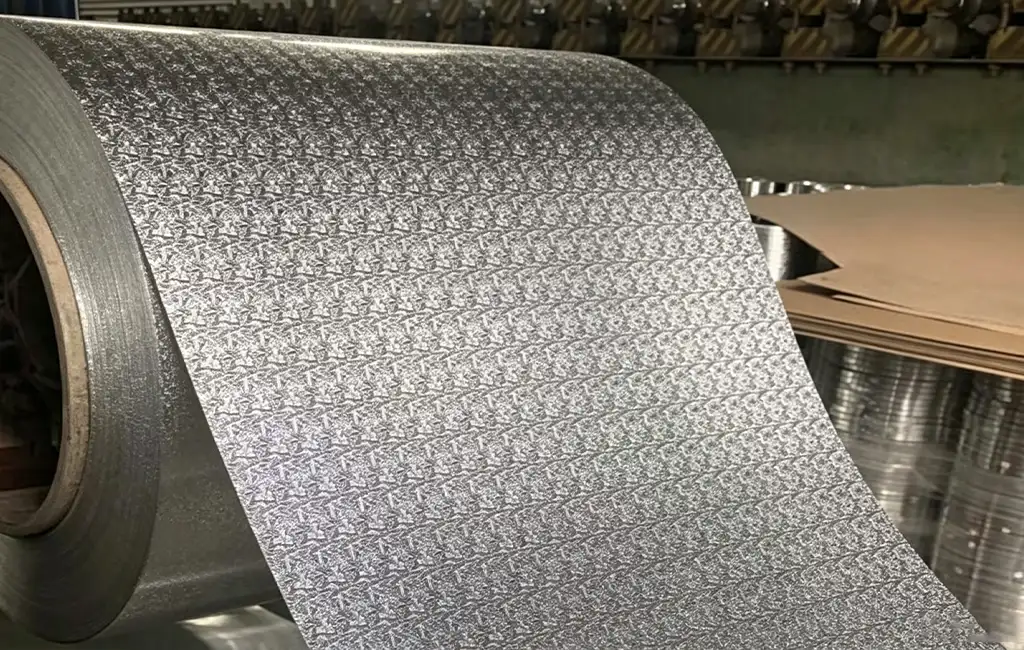
2. Thermal Insulation & Industrial Pipe Jacketing
Industrial insulation cladding for steam lines, storage tanks, and petro-chemical piping requires materials that resist mechanical denting while maintaining low emittance.
- Mechanical Resilience: Embossed pattern geometries increase the stiffness-to-weight ratio compared to smooth aluminum of the identical gauge (AA3003/AA1060), resisting impact damage during installation and maintenance.
- Moisture Barrier Integration: Sheets are frequently laminated with a Polymer Moisture Barrier (Polysurlyn/PSMB) or factory-applied kraft paper to prevent galvanic corrosion occurring at the insulation-metal interface per ASTM C1729.
3. HVAC Systems, Ducting & Heat Exchangers
Embossed aluminum is a primary material for pre-insulated HVAC ductwork panels (e.g., Polyisocyanurate/PIR foam ducts) and evaporator background plates.
- Surface Area Enhancement: Micro-stucco embossing increases the active heat dissipation surface area by 8% to 15% compared to flat sheet stock without increasing volumetric footprint.
- Acoustic and Airflow Efficiency: In air distribution systems, the textured internal surface breaks boundary-layer air laminar friction, reducing high-frequency turbulence noise while increasing the structural rigidity of thin-wall ducting.