
Technical Analysis: 5000-Series vs. 3000-Series Color-Coated Aluminum in Deep-Drawn and Curved Architectural Panels
5000-series aluminum alloys (Al-Mg system, e.g., [1] 5052, [2] 5083) outperform 3000-series alloys (Al-Mn system, e.g., 3003, 3105) in deep-drawn and complex curved panel applications due to superior mechanical ductility, higher strain-hardening exponents (n-value), and advanced limiting drawing ratios (LDR ≥ 2.1 vs. LDR ≤ 1.8). Magnesium solid-solution hardening provides tensile strengths between 210–310 MPa while maintaining elongation rates above 15–25%, preventing strain localization, cracking, and orange-peeling during intense hydraulic press forming or roll bending. Paired with high-flexibility PVDF coatings (100% Kynar 500/Hylar 5000 resin system, T-bend rating 0T–1T), 5000-series color-coated coils deliver fracture-free curvature, structural integrity, and long-term corrosion resistance under severe mechanical stress.
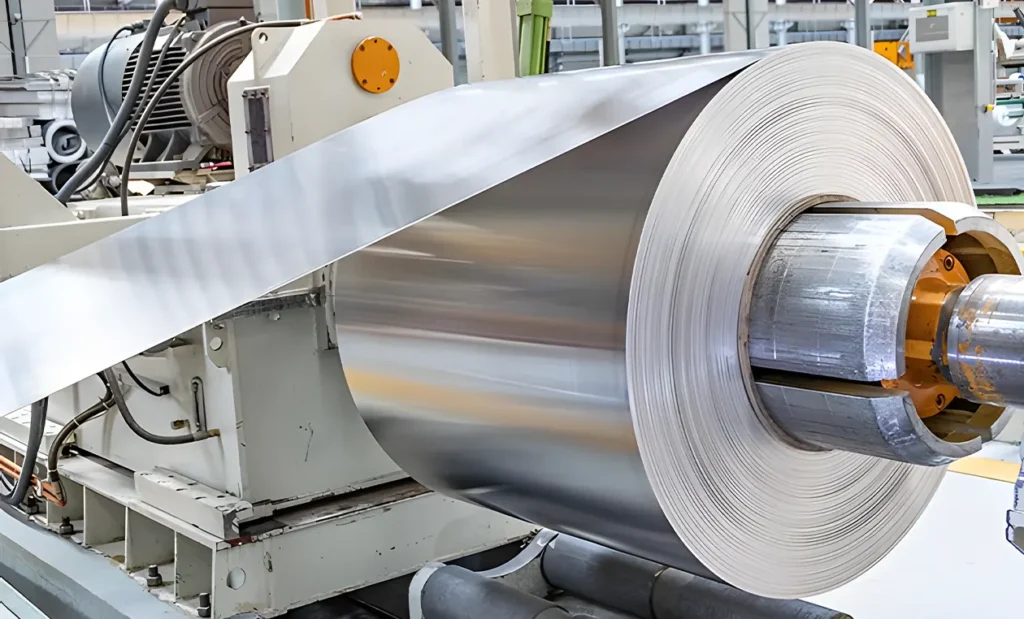
Technical Parameter Comparison: 5000-Series vs. 3000-Series Color Aluminum
The matrix below contrasts the core mechanical, chemical, and coating specs for deep-drawing and roll-forming structural applications:
| Technical Parameter | 3003-H14 Color Aluminum | 3105-H24 Color Aluminum | 5052-O / H32 Color Aluminum | 5083-O Color Aluminum |
| Alloy System & Composition | Al-Mn (1.0–1.5% Mn) | Al-Mn-Mg (0.3–0.8% Mn, 0.2–0.8% Mg) | Al-Mg (2.2–2.8% Mg, 0.15–0.35% Cr) | Al-Mg (4.0–4.9% Mg, 0.4–1.0% Mn) |
| Tensile Strength (Rₘ) | 140 – 180 MPa | 150 – 200 MPa | 210 – 260 MPa | 270 – 345 MPa |
| Yield Strength (Rₚ₀.₂) | 115 – 150 MPa | 120 – 170 MPa | 130 – 180 MPa | 145 – 200 MPa |
| Elongation at Break (A₅₀ₘₘ) | 8% – 12% | 7% – 10% | 18% – 25% | 16% – 22% |
| Strain-Hardening Exponent (n-value) | 0.11 – 0.14 | 0.10 – 0.13 | 0.20 – 0.23 | 0.21 – 0.24 |
| Limiting Drawing Ratio (LDR) | 1.65 – 1.80 | 1.60 – 1.75 | 2.10 – 2.25 | 2.15 – 2.30 |
| Salt Spray Corrosion Resistance | 1,500 Hours (ASTM B117) | 1,500 Hours (ASTM B117) | 3,000+ Hours (ASTM B117) | 4,000+ Hours (ASTM B117) |
| Coating System Compatibility | PE / standard PVDF | PE / standard PVDF | Flexible PVDF / FEVE / Powder | Flexible PVDF / FEVE |
| Coating T-Bend Flexibility | 2T – 3T (Risk of micro-cracking) | 2T – 3T | 0T – 1T (Zero cracking / flaking) | 0T – 1T |
| Primary Industrial Applications | Flat siding, standard gutters | Flat ceiling tiles, simple trim | Deep-drawn hyper-bow facades, curved cassettes | Marine structures, high-stress curved facades |
Metallurgical Mechanisms: Strain-Hardening and Drawability in Deep Forming
Deep-drawing and roll-curving subject coil-coated sheets to multi-axial tensile stress and biaxial stretching. The primary factor governing metal flow without localized necking is the strain-hardening exponent (n-value).
High n-Value Prevents Localized Necking
- 3000-Series Limitations: The Manganese manganese-aluminide (Al₆Mn) dispersoids in 3003 aluminum increase yield strength moderately but provide limited work-hardening capacity (n ≈ 0.12). Under deep-drawing ratios above 1.8, stress concentrates rapidly, causing thinning, shear failure, and severe surface orange-peeling.
- 5000-Series Advantage: Dissolved Magnesium atoms in the 5052 and 5083 matrices create solute-atom atmospheres that pin dislocations (solid-solution hardening). This increases the n-value to 0.20–0.23, allowing the strain to distribute uniformly across the panel geometry during deep drawing.
Limiting Drawing Ratio (LDR) Performance
In hydraulic deep drawing, the Limiting Drawing Ratio measures the maximum blank diameter relative to the punch diameter before fracturing occurs:
LDR = Dblank, max / dpunch
Whereas 3003-H14 reaches its mechanical limit at an LDR of 1.70–1.80, 5052-O/H32 consistently achieves an LDR of 2.10–2.25. This difference enables fabricators to execute single-pass deep draws for hyper-bowed cladding, spherical dome panels, and complex corners without intermediate annealing steps.
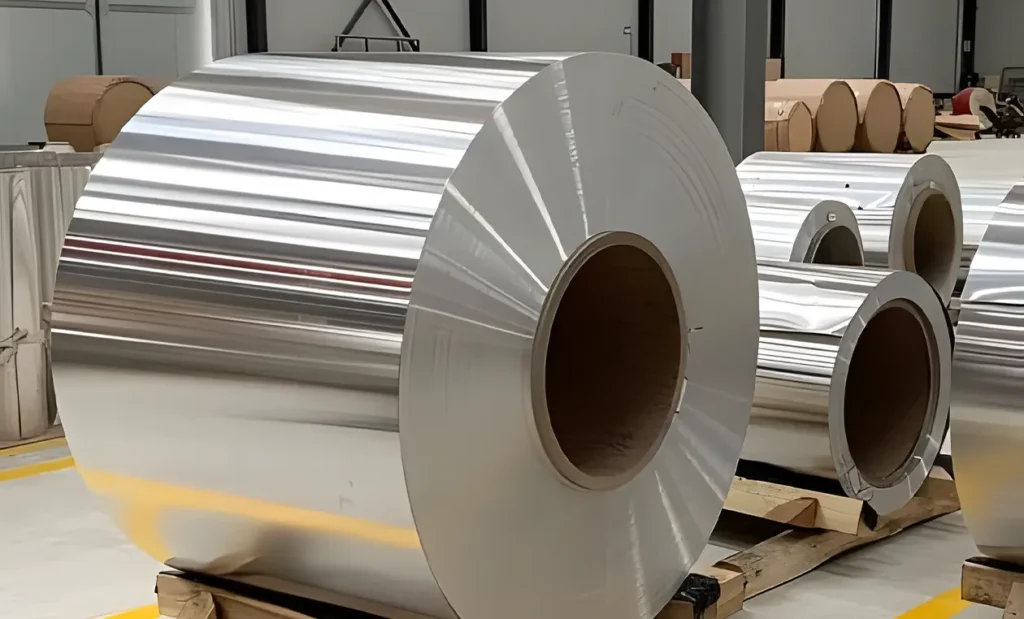
Surface Integrity and Coating Adhesion Under Mechanical Strain
A critical challenge in coil-coated aluminum manufacturing is preserving coating adhesion and surface aesthetics during severe post-coating fabrication.
Coating-Substrate Strain Synchronization
When color aluminum is bent or stretched to small radii, the outer coating layer experiences significant elongation:
εouter = t / (2R + t)
(where t is sheet thickness and R is bend radius).
- 3000-Series Behavior: Uneven deformation in the underlying 3003 matrix exerts localized shear stress at the coating interface, resulting in micro-fractures, gloss loss, and eventual delamination under [3] ASTM D3359 cross-hatch tape testing.
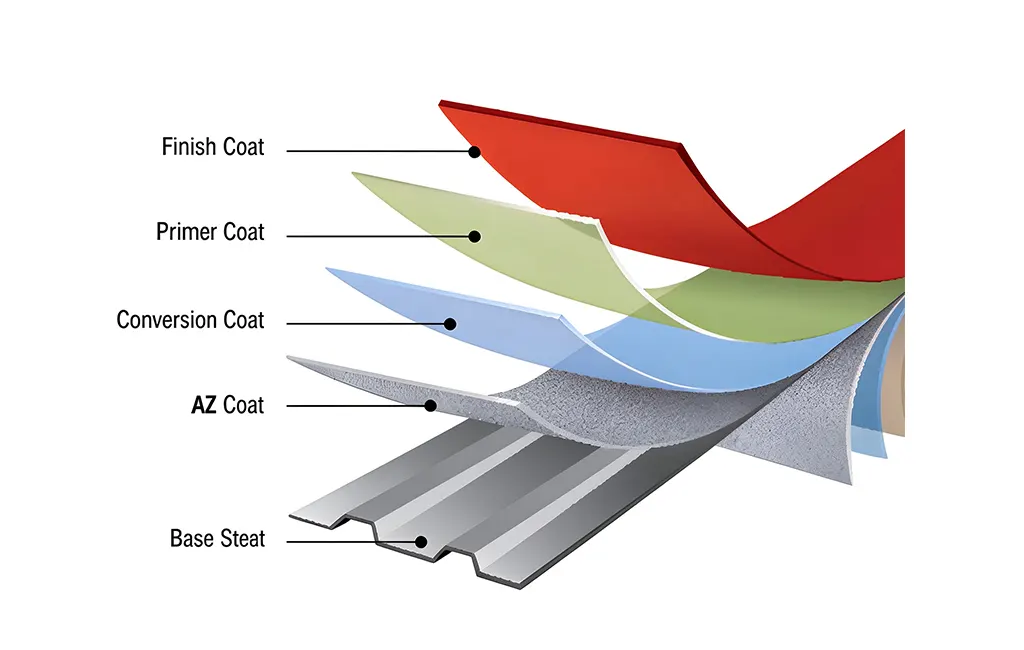
- 5000-Series Behavior: Uniform plastic deformation in 5052 aluminum supports continuous stress transfer to the flexible PVDF primer system. Using high-molecular-weight PVDF resins combined with elastomeric acrylic modifiers allows the paint layer to elongate synchronously with the metal substrate up to 20% strain without micro-cracking.
Corrosion Resistance at Deformed Zones
Standard roll-formed edges and deep-drawn corners often become sites for early micro-corrosion:
- Intergranular Protection: The inclusion of 0.15–0.35% Chromium in 5052 alloy refines grain structures and neutralizes iron impurities, preventing grain-boundary precipitation.
- Salt Spray Compliance: Even at high-strain deep-drawn radiused corners, 5052 color-coated panels maintain paint adhesion and pass 3,000+ hours of [4] ASTM B117 salt spray exposure, whereas 3003 panels risk blistering along strain paths after 1,200–1,500 hours.
References
[1] Wikipedia. 5052 aluminium alloy [EB/OL]. 2026-09-30.
[2] Wikipedia. 5083 aluminium alloy [EB/OL]. 2026-09-30.
[3] Wikipedia. Paint adhesion testing [EB/OL]. 2026-09-30.
[4] Wikipedia. Salt spray test [EB/OL]. 2026-09-30.