
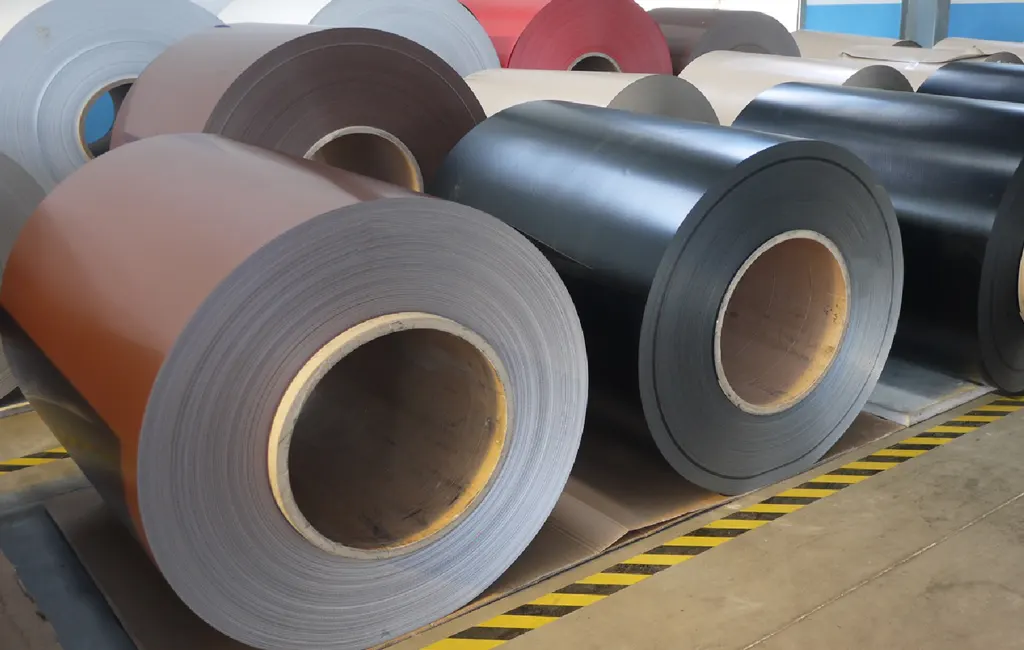
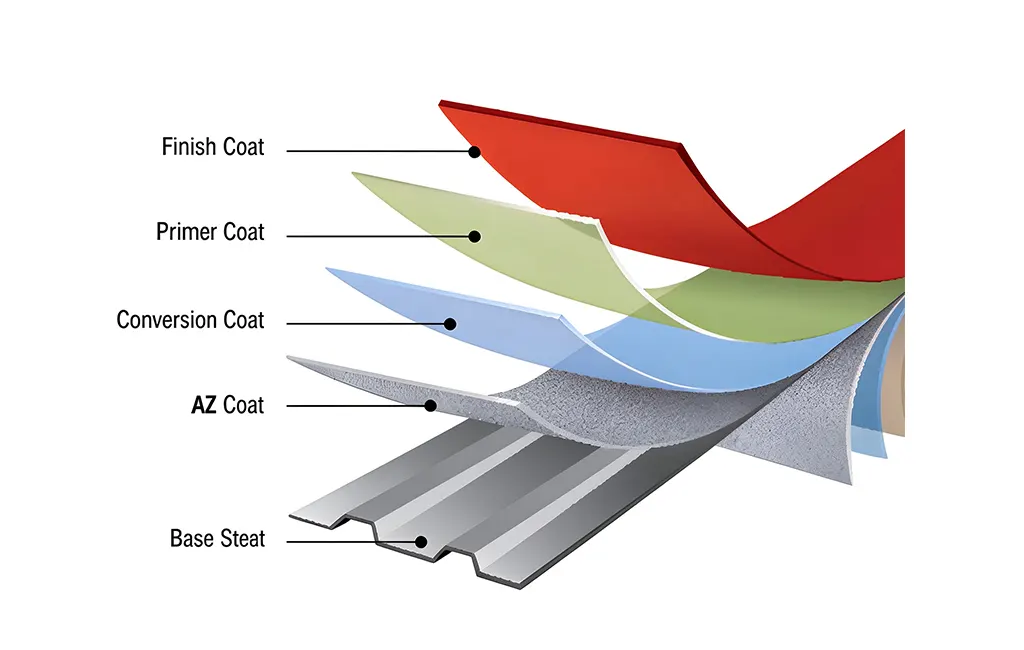
back-coat quality directly determines the long-term service life, structural integrity, and corrosion resistance of color-coated aluminum panels. While the architectural focus typically centers on the front-side PVDF coating [1], the reverse-side back-coat (commonly a 5μm to 15μm thick polyester, epoxy, or polyurethane coating) acts as the primary barrier against moisture diffusion, alkaline attack from insulation materials, and backside oxidation. In demanding environments—such as marine or industrial applications complying with AAMA 2605 and ISO 12206 standards—a substandard back-coat leads to premature blistering, chalking, and localized delamination, ultimately causing failure of the entire building envelope system.
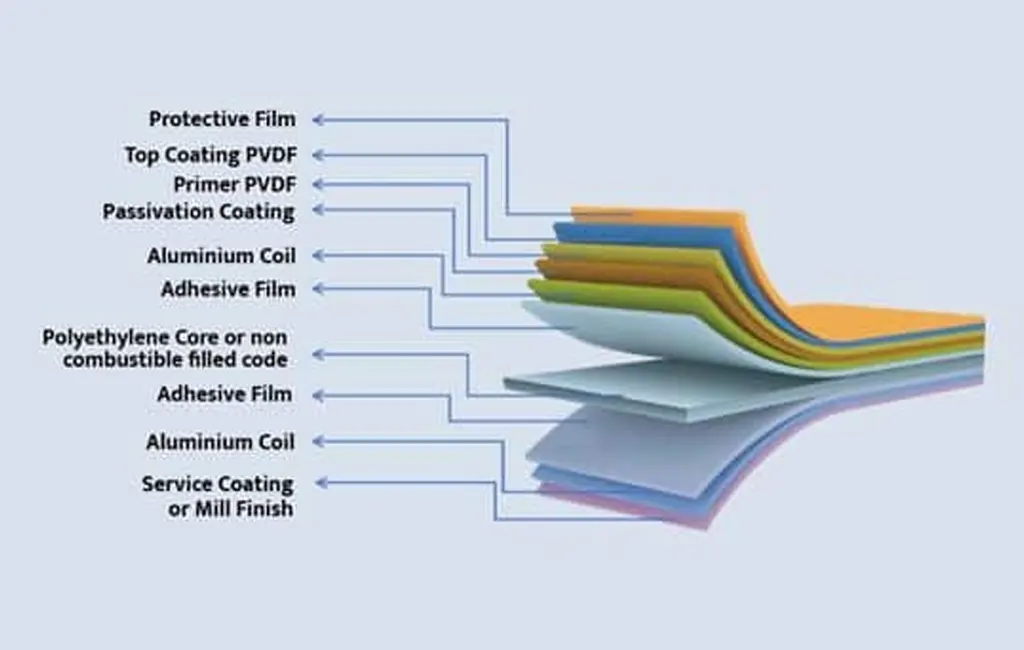
Technical Specifications and Performance Matrix
The following matrix compares standard technical parameters of architectural-grade color-coated aluminum coils, highlighting the interaction between front-coat systems, back-coat formulations, and overall environmental durability.
| Parameter | Standard Architectural Spec (Premium) | Standard Industrial Spec |
| Aluminum Alloy Grade | 3003-H24 / 5052-H24 | 1100 / 3003-H14 |
| Front-Coat Type | PVDF (Polyvinylidene Fluoride, \ge 70\%) | PE (Polyester) or SMP |
| Front-Coat Thickness | 25 μm – 28 μm (Two-coat system) | 18 μm – 22 μm |
| Back-Coat Type | Epoxy or Modified Polyester ($\ge 7 \mu m$) | Thin clear wash coat or low-grade PE |
| Back-Coat Thickness | 7 μm – 10 μm | 3 μm – 5 μm |
| Salt Spray Resistance (ASTM B117) | \ge 3000$ hours (No blistering or scribe creep) [2] | \ge 1000 hours |
| Color Retention (QUV Test) | \ge 95\% after 3000 hours (Delta E \le 2) | \ge 80\% after 1000 hours |
| Operating Temperature Range | -50^\circ\text{C} to +120^\circ\text{C} | -40^\circ\text{C} to +90^\circ\text{C} |
Mechanisms of Back-Side Degradation in Aluminum Panels
Moisture Trapping and Condensation
During daily thermal cycling, water vapor can permeate porous insulation layers or unsealed joints behind exterior cladding. When moisture contacts the reverse side of a color-coated aluminum sheet, a low-quality back-coat allows moisture to reach the metal substrate. This triggers subsurface oxidation, leading to localized bubbling and loss of adhesion between the paint film and the chromate/chromium-free pretreatment layer.
Chemical Interaction with Insulation Materials
In composite panels and insulated metal wall systems, the reverse side frequently contacts rigid polyurethane [3] foam (PUR), polyisocyanurate (PIR), or mineral wool. Unstable curing agents or residual alkalinity in insulation materials can chemically attack inferior back-coats. A robust, highly cross-linked epoxy back-coat provides the necessary chemical inertness to resist alkali degradation over decades of service.
Industry Standards, Testing Protocols, and Compliance
Ensuring long-term performance requires adherence to rigorous international standards that govern both sides of pre-painted metal coils:
- AAMA 2605-20: The industry benchmark for high-performance organic coatings on architectural aluminum extrusions and panels, mandating strict cyclic corrosion and weathering performance.
- ISO 12206-1: Specifies requirements for paints and varnishes applied to aluminum alloy substrates for architectural applications, including reverse-side film thickness and hardness requirements.
- GB/T 5237.5: The Chinese national standard for wrought aluminum alloy extruded profiles and coated sheets, detailing strict mechanical and chemical resistance benchmarks.
- ASTM B117 / ASTM D714: Standard test methods for salt spray (fog) evaluation and rating degree of blistering on coated metal specimens, verifying back-side protective limits.
References
[1] Wikipedia. Polyvinylidene fluoride [EB/OL]. 2026-10-20.
[2] Wikipedia. Salt spray test [EB/OL]. 2026-10-20.
[3] Wikipedia. Polyurethane [EB/OL]. 2026-10-20.