

Controlling Edge Burrs in Custom Slit Aluminum Strip
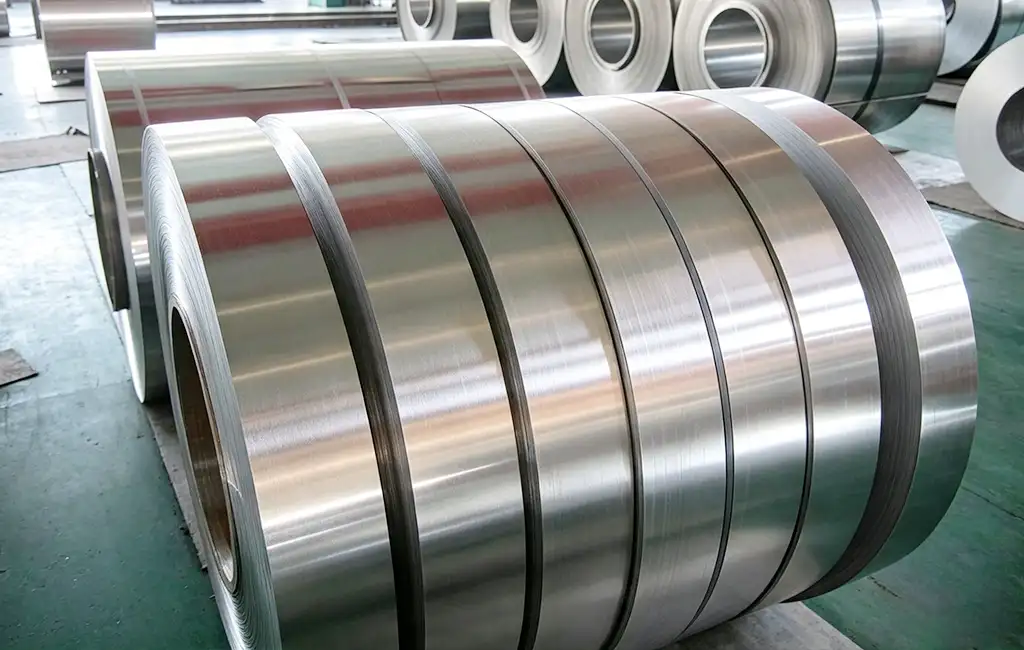
Edge burr formation in custom aluminum slitting occurs when shear stresses exceed the ultimate tensile strength of the material prematurely, causing excessive plastic deformation rather than a clean fracture. Controlling burr height to within industry standards—typically less than 10% of total strip thickness or under 0.02 mm for precision electronics and transformer windings—requires precise calibration of the vertical clearance, horizontal overlap, and blade shear geometry. Key factors include maintaining a 10% to 15% clearance relative to strip thickness, using tungsten carbide rotary knives with knife runout under 0.005 mm, and matching arbor deflection limits. Proper tensioning, correct stripper ring shore hardness, and sharp blade profiles directly eliminate heavy roll-overs and micro-cracks along the slit edge.
Technical Parameter Comparison for Slitting Aluminum Alloys
The optimal slitting setup varies significantly based on the temper, yield strength, and alloy series of the coil. The matrix below outlines standardized slitting parameters and burr tolerance limits across common aluminum strip applications.
| Parameter / Metric | 1050 / 1060 (O Temper) | 3003 / 3105 (H14/H24) | 5052 / 5083 (H32/H34) | 6061 (T6 Temper) |
| Yield Strength (MPa) | 30 – 50 | 115 – 165 | 195 – 240 | 240 – 270 |
| Typical Thickness Range (mm) | 0.20 – 1.50 | 0.30 – 3.00 | 0.50 – 4.00 | 0.80 – 6.00 |
| Blade Clearance (% of Thickness) | 6% – 8% | 8% – 12% | 10% – 14% | 12% – 16% |
| Horizontal Overlap / Penetration (mm) | 0.20 – 0.50 | 0.30 – 0.80 | 0.50 – 1.20 | 0.50 – 1.50 |
| Maximum Target Burr Height | ≤0.015ₘₘ | ≤0.025ₘₘ | ≤0.035ₘₘ | ≤0.040ₘₘ |
| Stripper Ring Hardness (Shore A) | 60 – 70 | 70 – 80 | 80 – 85 | 85 – 90 |
| Primary Industry Applications | Transformer Windings, Cable Wrapping | Roofing, Gutters, HVAC Fins | Marine Housings, Automotive Trim | Structural Components, Aerospace |
Causes and Prevention of Slitting Edge Burrs
Rotary Knife Wear and Blade Edge Geometry
As rotary shearing blades wear, the cutting edge transitions from a sharp right angle to a rounded radius. This increase in cutting edge radius alters the stress distribution in the aluminum strip, increasing tensile drawing forces before crack propagation occurs. The resulting edge exhibits an elongated, rolled-over lip (burr) alongside a deep burnish band.
- Prevention: Maintain a scheduled blade regrinding cycle based on linear meters processed. Utilize tungsten carbide knives (WC-Co grade) for high-volume coil processing to extend edge life up to 5 times longer than standard D2/M2 tool steel blades.
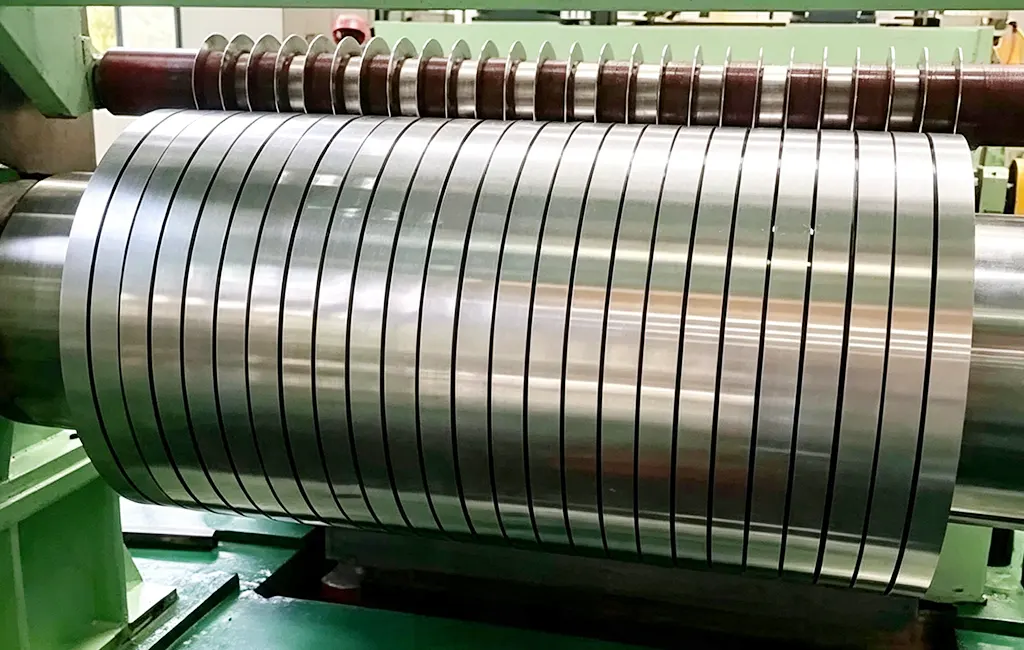
Incorrect Horizontal Blade Clearance
Clearance that is too small forces the upper and lower fracture lines to miss each other, causing secondary shearing and double-burrs (metal slivers). Conversely, excessive clearance causes the soft aluminum to bend into the gap between blades before snapping, resulting in a large downward burr and heavy edge wave.
- Prevention: Match clearance precisely to yield strength. Soft alloys (1000/3000 series) require tighter clearances (6% to 10%) to prevent material drawing, while high-strength alloys (5000/6000 series) require wider clearances (10% to 16%) to encourage clean fracture propagation.
Strip Waviness and Mechanical Deflection
Inconsistent line speed, improper recoil tension, or excessive arbor deflection under load cause the strip to tilt relative to the cutting plane. When the material does not enter the knives perfectly flat, one side of the slit edge experiences excessive clearance while the opposite side experiences zero clearance, creating alternating burrs along the coil length.
- Prevention: Utilize dual-head slitting arbors with intermediate support bearings for wide coils. Install precision tension leveling lines upstream of the slitter to eliminate camber and oil-canning prior to shearing.