
Preventing Coating Damage in Curved Roof Profiles Using Color-Coated Aluminum Coils
Fabricating color-coated aluminum coils into curved roof profiles requires strict control over the material’s structural and mechanical limits to prevent micro-cracking, tension whitening, or delamination of the protective layer. The primary consideration is balancing the minimum bend radius of the selected aluminum alloy with the T-bend flexibility of the organic coating (typically PVDF or Polyurethane-Polyamide modified paint). When aluminum undergoes radial forming, the outer surface experiences tensile stress; if this elongation exceeds the coating’s maximum elasticity threshold, micro-fractures occur, exposing the underlying metal substrate to accelerated galvanic and atmospheric corrosion.

Technical Performance Matrix for Curved Roofing Applications
The table below outlines the mechanical and coating specifications required for color-coated aluminum coils subjected to roll-forming and curving processes.
| Parameter | 3004 Aluminum Alloy (Al-Mn-Mg) | 3005 Aluminum Alloy (Al-Mn) | 5052 Aluminum Alloy (Al-Mg) |
| Typical Temper | H24 / H44 | H24 / H44 | H34 / H44 |
| Coating Chemical System | PVDF (70% Kynar 500) | High-Durability Polyester (HDP) | Polyurethane-Polyamide (PUFA) |
| Coating Thickness (Top Coat) | 25μm to 28μm | 20μm to 25μm | 25μm to 30μm |
| T-Bend Flexibility Rating | ≤ 1.5T without cracking | ≤ 2.0T without cracking | ≤ 1.0T without cracking |
| Minimum Curved Radius ($R$) | ≥ 3000mm (Smooth Curve) | ≥ 4000mm (Smooth Curve) | ≥ 2500mm (Structural Curve) |
| Impact Resistance Standard | ≥ 50 kg·cm (ASTM D2794) | ≥ 45 kg·cm (ASTM D2794) | ≥ 60 kg·cm (ASTM D2794) |
| Salt Spray Resistance | 4000 Hours (ISO 9227) | 3000 Hours (ISO 9227) | 5000 Hours (ISO 9227) |
| AAMA Compliance | AAMA 2605-20 | AAMA 2604-20 | AAMA 2605-20 |
Modular Technical Breakdowns
Impact of Substrate Yield Strength on Coating Elasticity
The choice of aluminum alloy directly dictates how stress is transferred to the surface finish during curved forming. Alloys like 3004 and 5052 offer an excellent strength-to-weight ratio but exhibit distinct yield strengths (Rp0.2). When an aluminum sheet is curved, the neutral axis retains its original length, while the outer surface undergoes elongation (ε).
If a high-yield-strength temper is processed on a curve with a small radius, the localized stress concentration causes rapid mechanical thinning of both the metal and the polymeric topcoat layer. This thinning leads to “tension whitening”—a visual defect where light scatters off micro-voids formed inside the stretched paint matrix, compromising UV resistance under AAMA 2605 parameters.
PVDF vs. HDP Coating Response to Radial Tension
Organic coatings respond differently to the continuous tensile forces present during the radial curving of roofing panels:
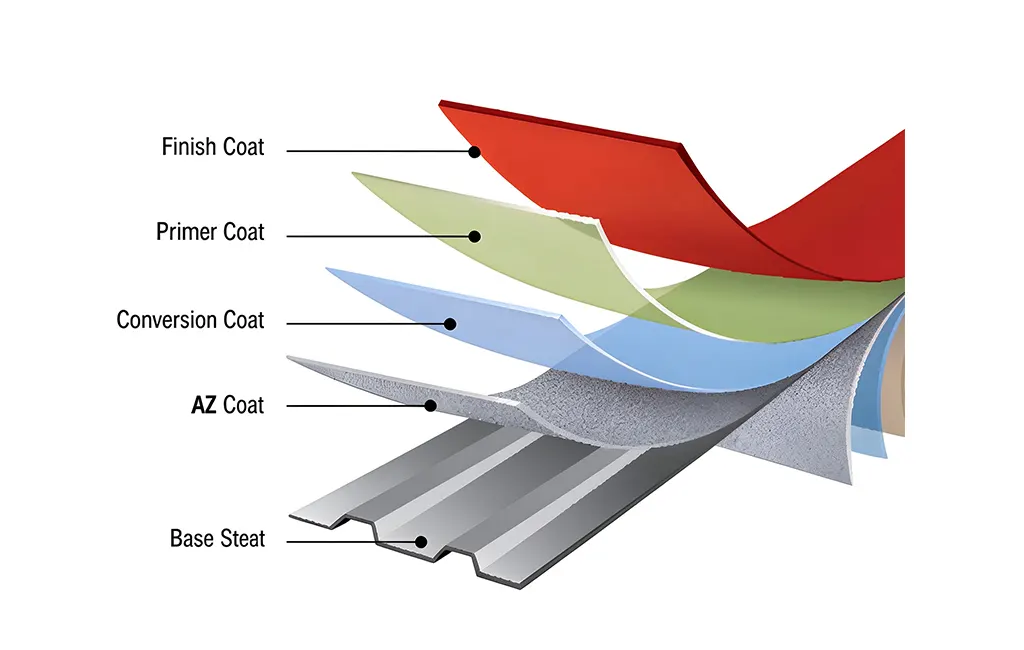
- Fluoropolymer (PVDF) Coatings: Formulated with 70% Polyvinylidene Fluoride resin, these coatings provide superior molecular flexibility. The carbon-fluorine bonds allow the matrix to stretch during smooth radius curving without delaminating from the polyurethane or epoxy primer coat.
- High-Durability Polyester (HDP): While cost-effective, HDP possesses a highly cross-linked structure that offers high hardness but reduced linear elasticity. HDP-coated coils are susceptible to micro-fracturing along the peaks of corrugated profiles when subjected to tight, crimp-curved geometries.

Mitigation of Crimp-Curving Frictional Stress
For architectural designs requiring tight curves, crimp-curving (introducing periodic indented ribs to force the profile into a radius) is frequently deployed. This process represents the highest risk environment for coating damage.
The concentrated clamping pressure of the crimping dies can scratch, gall, or burnish the paint finish. To mitigate this risk, dies must be fitted with polished polyurethane or high-density nylon inserts, and the color-coated coil must utilize a specialized primer layer containing anti-galling additives to absorb localized kinetic energy impacts.