
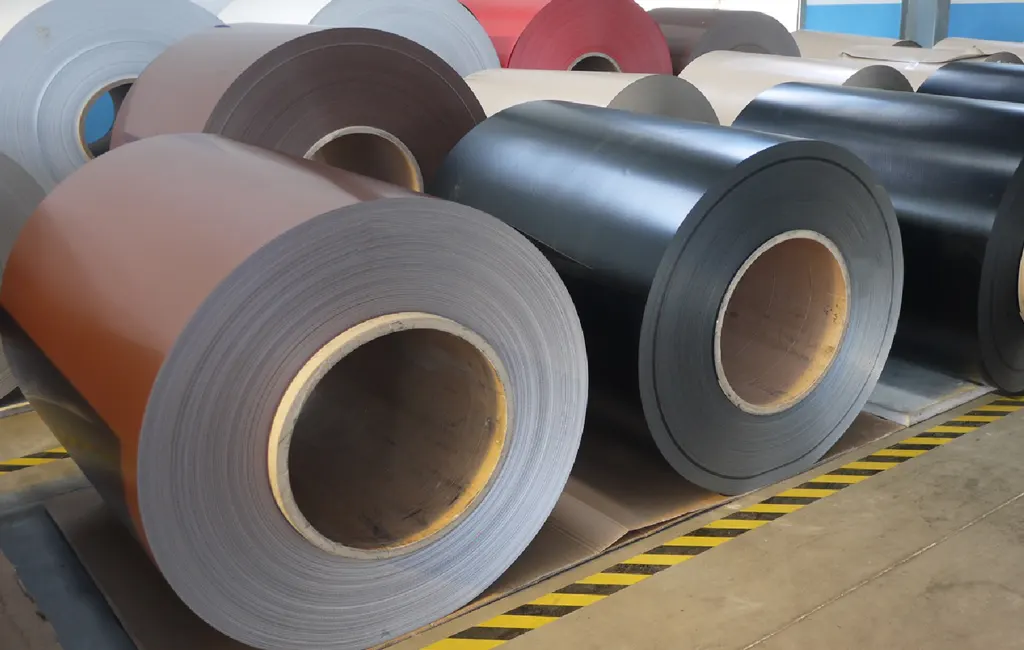
Coating cracking during roll forming [3] or bending occurs when mechanical deformation exceeds the elongation limits of the organic paint system relative to the aluminum substrate. Specifically, when the local tensile strain on the outer radius of a tight bend surpasses the coating’s elongation at break (typically 15% to 30% for high-grade PVDF [1] versus brittle polyesters), micro-fractures propagate through the paint film. Complying with ASTM D4145 (T-Bend Test) and ensuring proper substrate selection—such as utilizing ductile 3003-H14 [2] or 5052-H32 aluminum alloys—prevents interfacial delamination and catastrophic coating failure in architectural and industrial components.

Technical Parameter Matrix: Substrate vs. Coating Performance
| Aluminum Alloy Grade | Coating Type | Coating Thickness (µm) | Min. T-Bend Rating | Coating Elongation (%) | Standard Compliance | Primary Application |
| 3003-H14 | PVDF (Kynar 500) | 25 – 30 | 1T – 2T | ≥ 25% | AAMA 2605-20 | Architectural Curtain Walls |
| 5052-H32 | High-Durable Polyester (HDP) | 20 – 25 | 2T – 3T | ≥ 20% | ISO 12206-1 | Marine & Industrial Roofing |
| 1050H24 | Polyvinylidene Fluoride (PVDF) | 25 – 30 | 0.5T – 1T | ≥ 30% | GB/T 5237.5 | Interior Wall Panels & Trim |
| 6061-T6 | Thermoset Powder Coating | 60 – 80 | 4T – 6T | ≤ 10% | AAMA 2604 | Structural Extrusions & Trims |
Comparative Analysis of Elongation and Ductility Mismatch
Substrate Ductility and Work Hardening
The base aluminum alloy provides the structural integrity of the panel, but its temper dictates its forming limits. Alloys like 3003 (Al-Mn system) and 5052 (Al-Mg system) offer excellent formability [2]. However, excessive cold rolling or selecting hard tempers (e.g., -H18 instead of -H14) reduces the percent elongation of the metal. If the substrate’s internal crystalline structure cannot stretch uniformly under tension, localized necking occurs, fracturing the bonded paint layer regardless of the coating’s intrinsic flexibility.
Coating Elongation Properties
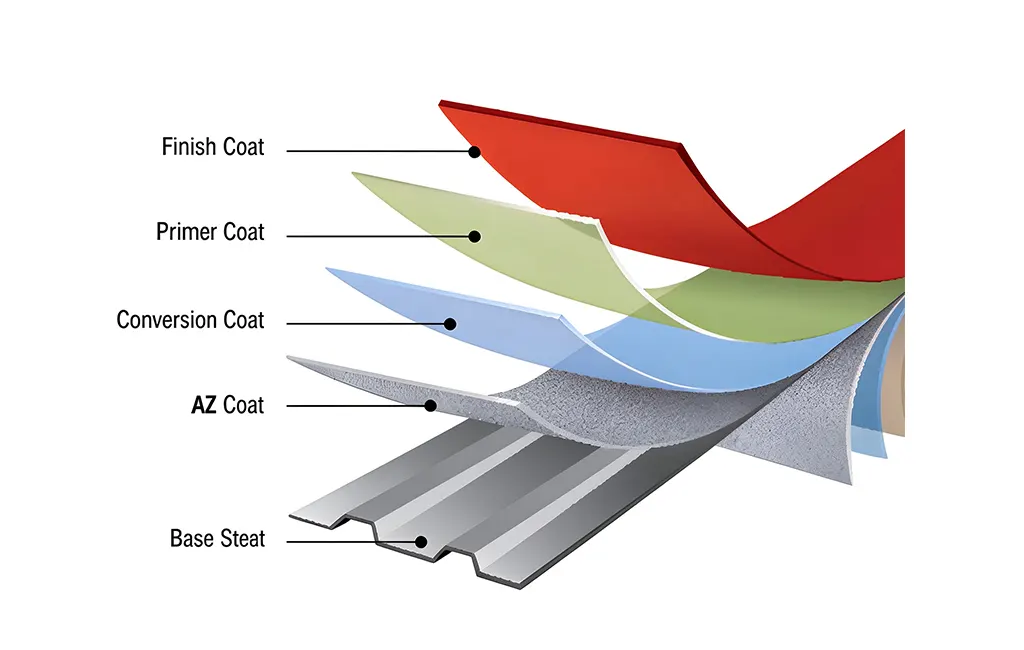
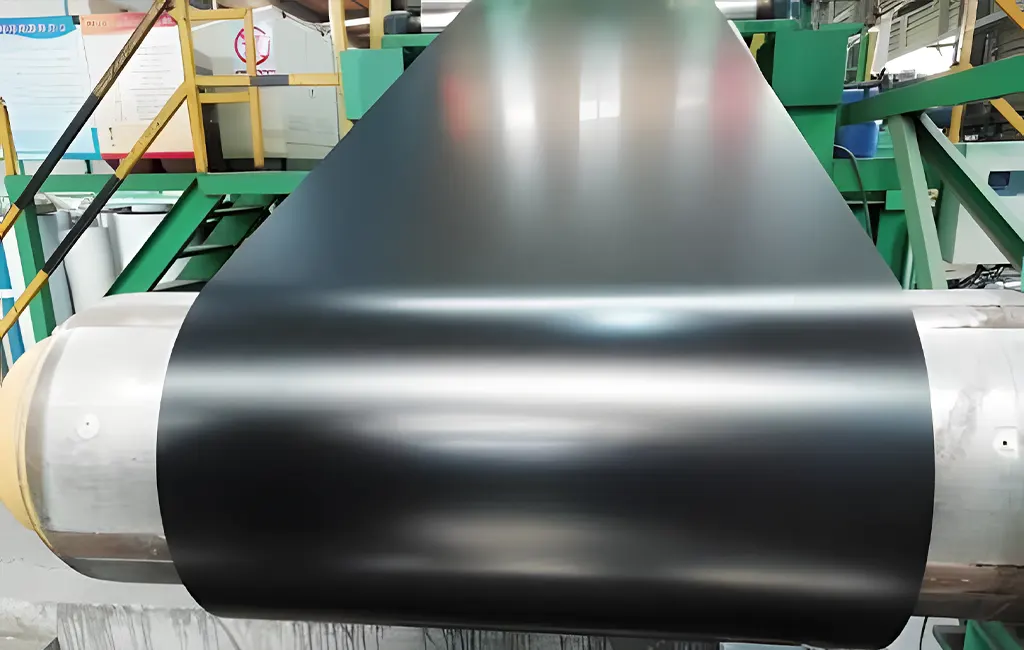
Organic coil coatings are composite matrices of resins, pigments, and cross-linking agents. Polyvinylidene Fluoride (PVDF) resins combined with acrylics provide superior molecular flexibility [1], allowing the paint film to stretch up to 30% without cohesive failure. Conversely, standard polyesters or high-crosslink epoxy primers have restricted chain mobility. When subjected to tight bend radii, rigid coatings suffer from micro-cracking, exposing the metallic pre-treatment layer to atmospheric moisture and galvanic corrosion.
The Role of Bend Radius and Tooling Clearance
The severity of bending stress is measured via the T-bend test (where 0T means the metal is folded flat on itself, and 1T means wrapping around one thickness of the sheet). Tight radii concentrate severe outer-fiber elongation over a microscopic surface area. Improper die clearance, worn press brakes, or sharp tooling shoulders exacerbate this by introducing localized shear forces, forcing the coating to elongate far beyond its elastic-plastic threshold.
References
[1] Wikipedia. Polyvinylidene fluoride [EB/OL]. 2026-10-10.
[2] Wikipedia. 3003 aluminium alloy [EB/OL]. 2026-10-10.
[3] Wikipedia. Roll forming [EB/OL]. 2026-10-10.