
Degreasing and conversion coating are foundational to coating longevity. Degreasing removes oils, waxes, and fingerprint oils that hinder wetting and cause pinholes, roughness, and delamination.
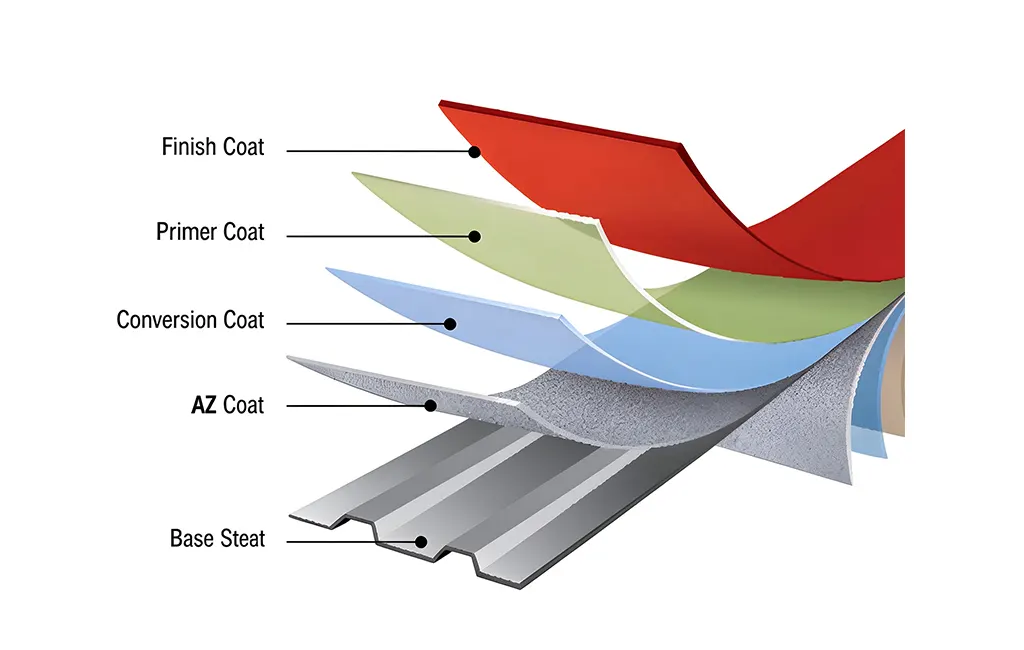
Conversion coatings (chromate or non-chromate) chemically modify the native Al2O3 layer to increase surface energy, provide a sacrificial barrier, and promote chemical bonding with the organic primer and fluoropolymer topcoat.
Together, they improve adhesion, corrosion resistance, and color stability by reducing underfilm corrosion pathways, ensuring uniform film formation, and minimizing defect initiation sites in humid, UV-rich tropical environments.

Key factors that influence longevity
Pretreatment compatibility: The activation layer must bond with both the primer and the fluoropolymer topcoat; mismatches reduce adhesion and promote delamination under moisture/UV exposure.
Surface energy and wetting: Higher surface energy from appropriate conversion coatings improves coating spread and reduces microvoids where moisture can migrate.
Oxide morphology: Controlled oxide thickness and roughness enhance mechanical interlock without introducing stress concentrations.
Environmental compatibility: Non-chromate coatings reduce environmental impact but must deliver equivalent adhesion and corrosion resistance for long-term color retention.
Alloy dependence: 6000-series alloys respond well to light etch and chromate activation; some high-strength alloys may require alternative pretreatments to avoid coating cracking.
Pretreatment options for aluminum (summary)
Chromate conversion coatings (CCC): Alodine, Iridite – excellent adhesion and corrosion protection; widely used in architectural and aerospace applications.
Non-chromate conversion coatings: Zirconium-based, titanium-based, manganese-based chemistries – lower environmental impact; may require system re-optimization for adhesion and long-term color stability.
Alkaline degreasing prior to activation: Standard for most coil-coating lines to ensure full removal of organics.
Surface-passivation alternatives: For strict environmental constraints, non-chromate routes with validated adhesion performance are used.
Process flow for production line pretreatment
1.Inspect incoming aluminum alloy and surface condition
Confirm alloy family (e.g., 6000/7000 series) and prior coatings if any.
2.Pre-wash with alkaline degreaser
Target temperatures ~50–60°C; dwell 2–5 minutes; rinse thoroughly.
3.Rinse to remove all residues
DI water rinse; monitor conductivity targets.
4.Optional light etch or activation
If required by alloy and current system; brief, controlled exposure.
5.Apply conversion coating (chromate or non-chromate)
Control coating bath concentration, temperature, and immersion time per system SOP.
6.Post-treatment rinse
DI water rinse to remove residual chemicals.
7.Drying
Dry to a non-condensing state; avoid moisture carryover to primer/topcoat.
8.In-line inspection
Visual cleanliness, uniform coating appearance, adhesion pre-checks.
9.Documentation
Record bath chemistry, dwell times, temperatures, lot numbers, and QA results.
10.Proceed to priming/topcoat
Ensure immediate transfer to minimize oxidation between pretreatment and coating.
Quality control integration
Surface cleanliness rating: Target SA 2 1/2 or better (ISO 8501-1) before coating.
Pre-treatment adhesion check: Optional cross-cut or pull-off after pretreatment if applicable to process.
Bath chemistry control: Regular titration/measurements for degreaser and conversion coatings; maintain within supplier-recommended ranges.
Post-pretreatment inspection: Visual uniformity, absence of streaks, resin runs, or white residue.