
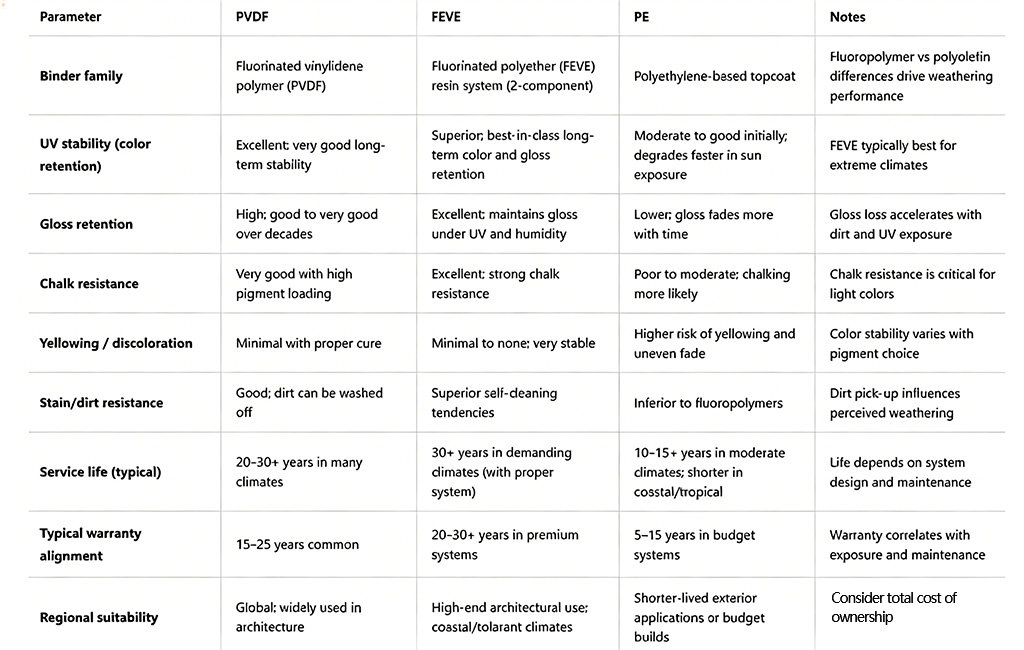
PVDF and FEVE are fluoropolymer topcoats with superior weathering performance; PE is a polyethylene-based coating with significantly lower UV and color-retention performance.
FEVE generally delivers the best long-term color stability, gloss retention, and stain resistance in harsh climates, followed by PVDF, which already offers excellent performance and wide industry acceptance.
PE coatings are more cost-driven and typically exhibit faster chalking, color change, and gloss loss in prolonged outdoor exposure.
Actual results depend on pigment load, binder system, film thickness, pretreatment, and cure quality.
Key factors that influence weathering performance
Topcoat chemistry: FEVE provides superior long-term color stability and gloss retention, especially in high-UV, high-humidity environments; PVDF is exceptional and widely adopted; PE lags behind fluoropolymers for outdoor longevity.
Pigment load and binder ratio: Higher fluoropolymer content improves chalking resistance and color fidelity; pigments with UV absorbers enhance stability.
Cure and film thickness: Adequate dry film thickness (DFT) and proper cure ensure full crosslinking, reducing moisture ingress and color shift.
Substrate and pretreatment: Aluminum pretreatment quality, cleanliness, and surface energy influence adhesion and barrier performance, which affects weathering outcomes indirectly.
Service environment: Coastal and tropical climates with salt spray, high UV, and high humidity favor FEVE or high-end PVDF systems; PE systems are more sensitive to these factors.
Maintenance: Regular washing and avoidance of deposits preserve color and gloss, especially for lighter colors where chalking is more noticeable.
Coating system overview (practical guidance)
PVDF coatings: Widely accepted for long service life, good color stability, and cost-efficiency; suitable for many architectural projects with durable warranties.
FEVE coatings: Offer the best long-term weathering performance, superior gloss retention, and stain resistance; ideal for harsh tropical/coastal climates or premium projects requiring extended warranties.
PE coatings: Lower-cost option with shorter weathering life; appropriate for sheltered or short-term exterior exposures or where budget constraints dominate.
Weathering testing and standards (how performance is demonstrated)
Accelerated weathering: ISO 4892-2/3, ISO 11507, or ASTM G53/G154; evaluate color change (ΔE), gloss retention, chalking (ASTM D4214), and haze.
Color and gloss measurement: ISO 11664 (CIE Lab*), ASTM D2244 for color, ASTM D523 for gloss.
Architectural performance: AAMA 2604/2605 (where applicable) and EN 13523 (for metal coatings) to verify long-term performance under outdoor exposure.
Environmental conditioning: Salt spray/mist exposure (for coastal climates) per ASTM B117 or ISO equivalents, combined with UV weathering cycles.
SOP / Checklist (Coating Selection for Weathering)
1.Define exposure environment
Coastal tropics vs inland, UV index, salt exposure, humidity, and temperature cycling.
2.Set performance targets
Desired color stability, gloss retention, and warranty duration (years).
3.Select topcoat family based on targets
FEVE for maximum long-term weathering; PVDF for strong, cost-effective performance; PE for budget-constrained, lower-exposure scenarios.
4.Verify pigment and binder balance
Ensure adequate fluoropolymer content and UV-stable pigments for your color and gloss targets.
5.Confirm cure and film thickness
Check recommended DFT and cure cycle; ensure uniform coating across substrates.
6.Review substrate pretreatment compatibility
Aluminum pretreatment quality, adhesion promoters, and surface energy levels compatible with chosen topcoat.
7.Review accelerated weathering data
Require supplier data showing ΔE* and gloss retention after defined hours (e.g., 5,000–10,000 hours UV exposure).
8.Plan field validation
Include outdoor exposure or real-climate tests where feasible; define acceptance criteria (ΔE*, gloss loss, chalk index).
9.Establish maintenance plan
Cleaning frequency and methods to minimize dirt-induced color drift.
10.Documentation and traceability
Record coating system, pigment, binder, cure, batch, and test results for warranties and audits.