Curing Temperature Impact on Coating Hardness and Flexibility
The curing temperature—specifically the Peak Metal Temperature (PMT)—is the primary determinant of the cross-linking density in color-coated aluminum resins like PVDF and PE. If the temperature is too low, the resin fails to fully polymerize, resulting in a soft coating with poor adhesion and low chemical resistance. Conversely, excessive curing temperatures lead to “over-baking,” which increases Pencil Hardness but causes the polymer chains to become brittle. This brittleness directly reduces T-bend flexibility, leading to micro-cracking during the roll-forming or bending process. Achieving the optimal PMT ensures a balance where the coating is hard enough to resist scratching (typically $\geq$ F-H) while remaining flexible enough for complex fabrication.
Technical Parameter Comparison: Curing Effects on Coating Performance
The following table illustrates how variations in the curing process affect the physical properties of the most common color aluminum coating types.
| Parameter | Under-Cured (Low PMT) | Optimal Curing (Standard PMT) | Over-Cured (High PMT) |
| Peak Metal Temp (PMT) | < 210°C | 232°C – 249°C | > 260°C |
| Pencil Hardness | < HB (Soft) | F – 2H | > 3H (Brittle) |
| T-Bend Flexibility | 0T – 1T (No cracking) | 0T – 2T (Standard) | > 3T (High risk of cracking) |
| MEK Rub Resistance | < 50 Cycles | > 100 Cycles | > 100 Cycles |
| Adhesion (Cross-hatch) | Poor (Peeling) | Excellent (5B) | Good (but prone to chipping) |
| Gloss Retention | High (but unstable) | Matches Specification | Significant Loss/Yellowing |
| Impact Resistance | High (Ductile) | Compliant (e.g., 9J) | Low (Coating shatters) |
The Relationship Between Cross-linking and Mechanical Properties
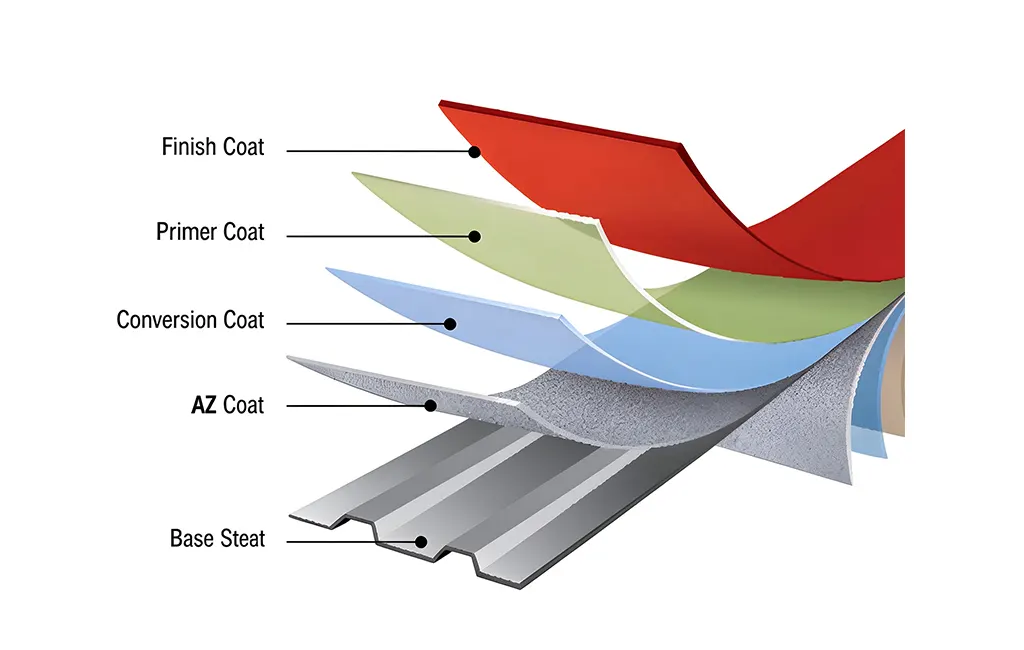
The core of color-coated aluminum performance lies in the Thermosetting nature of the coatings. During the curing cycle in the furnace, solvent evaporates, and the functional groups in the resin (such as hydroxyl or carboxyl groups) react with cross-linking agents (like melamine or isocyanates).
Hardness vs. Cross-linking Density
As the curing temperature increases toward the optimal PMT, the cross-linking density rises. A denser molecular network provides higher resistance to mechanical indentation and abrasion. This is vital for applications like commercial facades and roofing panels, where wind-blown debris or installation handling can cause surface damage.
Flexibility and Polymer Chain Mobility
Flexibility is the coating’s ability to undergo rapid deformation without loss of adhesion or cohesive failure. If the curing temperature exceeds the recommended limit, the polymer chains become too constrained. This loss of “molecular slip” means that when the aluminum sheet is roll-formed into a corrugated profile, the coating cannot stretch with the substrate, leading to crazing or spalling.