
Mechanical Durability of Color-Coated Aluminum: Impact of Scratch and Abrasion Resistance
The scratch resistance and abrasion resistance of color-coated aluminum coatings directly determine the material’s structural integrity, aesthetic longevity, and total lifecycle cost. During installation, coatings are subjected to mechanical stresses including shearing, riveting, and tool impact; during service life, they face windblown particulate erosion and environmental weathering. Insufficient scratch resistance leads to micro-cracks that expose the underlying aluminum substrate to rapid filiform and galvanic corrosion. High abrasion resistance ensures the retention of the coating’s original dry film thickness (DFT), preventing premature degradation of UV-blocking pigments and preserving the structural bond between the pre-treatment layer and the topcoat.
Technical Parameter Matrix: Coating Durability Profiles
| Aluminum Alloy Grade | Coating Type | Standard Coating Thickness (μm) | Pencil Hardness (Scratch Resistance) | Taber Abrasion Resistance (Weight Loss / 1000 cycles) | Salt Spray Test Resistance (ASTM B117) | Primary Application Scenarios |
| 3003-H14 / H24 | PVDF (70% Kynar 500) | 25 – 35 (Two-Coat/Three-Coat) | ≥ F – H | ≤ 40 mg | ≥ 3,000 Hours | Architectural curtain walls, commercial facades, roofing systems |
| 5052-H32 | Super Durable Polyester (SDP) | 20 – 25 | ≥ H | ≤ 50 mg | ≥ 2,000 Hours | Industrial enclosures, coastal building panels, transportation components |
| 6061-T6 | Thermoset Powder Coating | 60 – 80 | ≥ 2H | ≤ 20 mg | ≥ 4,000 Hours | High-traffic public infrastructure, heavy-duty machinery housings |
| 1100-H14 | Regular Modified Polyester (PE) | 15 – 20 | ≥ F | ≤ 70 mg | ≥ 1,000 Hours | Indoor signage, interior ceiling grids, residential rainwater goods |
Coating Degradation Mechanisms During Installation
Tool Impact and Gouging Forces
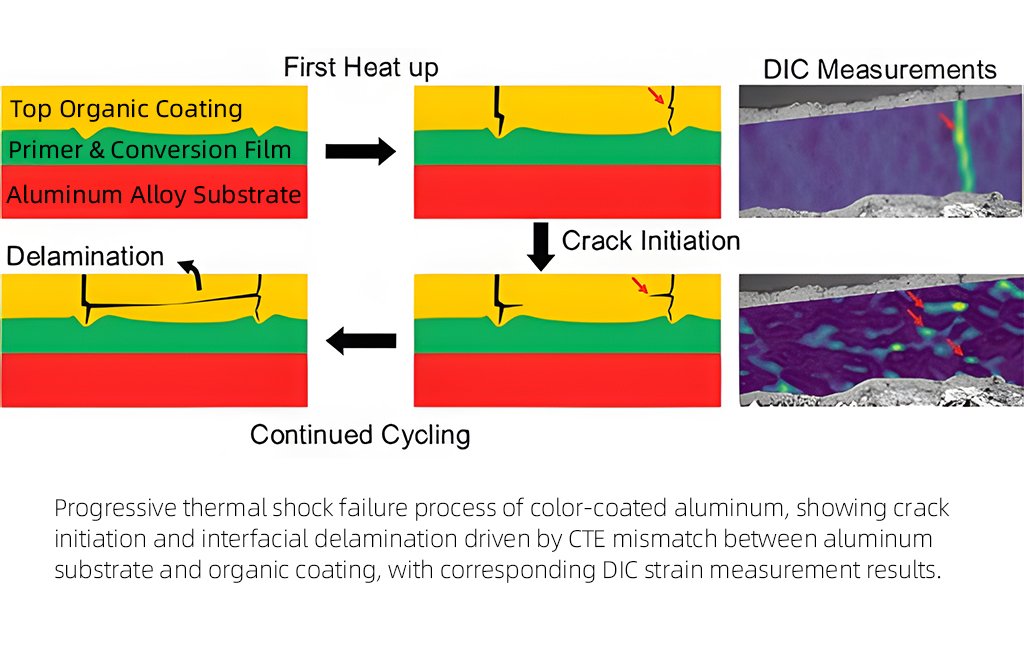
During the fabrication and installation phases of commercial facades or curtain walls, color-coated aluminum undergoes intense mechanical handling. Actions such as cutting, punching, riveting, and field-bending exert localized shear forces on the coating polymer matrix. If the scratch resistance—measured by pencil hardness or clemen scratch testers—is substandard, the topcoat will experience cohesive or adhesive failure. This delamination exposes the conversion coating or raw aluminum alloy directly to atmospheric oxygen and moisture.
Roll-Forming and Micro-Cracking
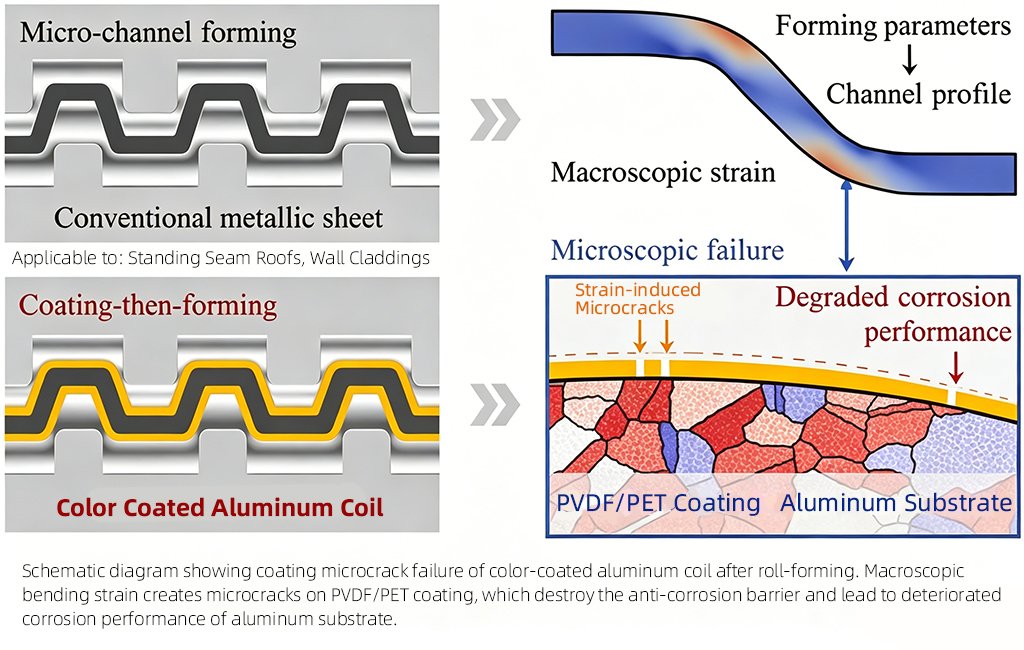
When panels undergo cold roll-forming to create standing seam roofs or trapezoidal profiles, the coating is subjected to extreme tensile elongation along the bend radii. Coatings with low elasticity paired with poor abrasion resistance will develop microscopic stress cracks at the crests and valleys of the profile. These micro-cracks compromise the barrier properties of the film, accelerating the onset of filiform corrosion under humid conditions.
Long-Term Service Life Performance and Environmental Erosion
Windblown Particulates and Volumetric Mass Loss
In service, building envelopes are continuously bombarded by windblown sand, dust, and environmental debris. This abrasive action acts as a continuous low-energy particle blasting process. A coating’s ability to resist mass loss—quantified by Taber Abrasion metrics—determines how long it can maintain its engineered dry film thickness. Once abrasion reduces the topcoat thickness below critical limits, the underlying primer is exposed, leading to rapid degradation of the entire coating system.
UV Degradation Amplified by Surface Roughness
Mechanical abrasion increases the microscopic surface roughness (Ra) of the color-coated aluminum. A rougher surface provides more surface area for atmospheric pollutants, industrial acids (SO₂), and marine salts (NaCl) to accumulate. Furthermore, this breakdown accelerates photo-oxidative degradation caused by UV radiation. High-performance coatings, such as Polyvinylidene Fluoride (PVDF), rely on strong Carbon-Fluorine (C-F) bonds to resist this combined chemical-mechanical attack, preserving color fastness and maintaining a color retention rate of ≥95% after 10 years of outdoor exposure.