
Topcoat Degradation Mechanisms Under High-UV Tropical Exposure
In tropical climates, ultraviolet (UV) radiation—specifically high-energy UV-A and UV-B photons—acts as the primary catalyst for the chemical degradation of topcoat polymers on color-coated aluminum coils. This process, known as photodissociation, occurs when the absorption of UV light breaks the covalent chemical bonds within the binder resin matrix.
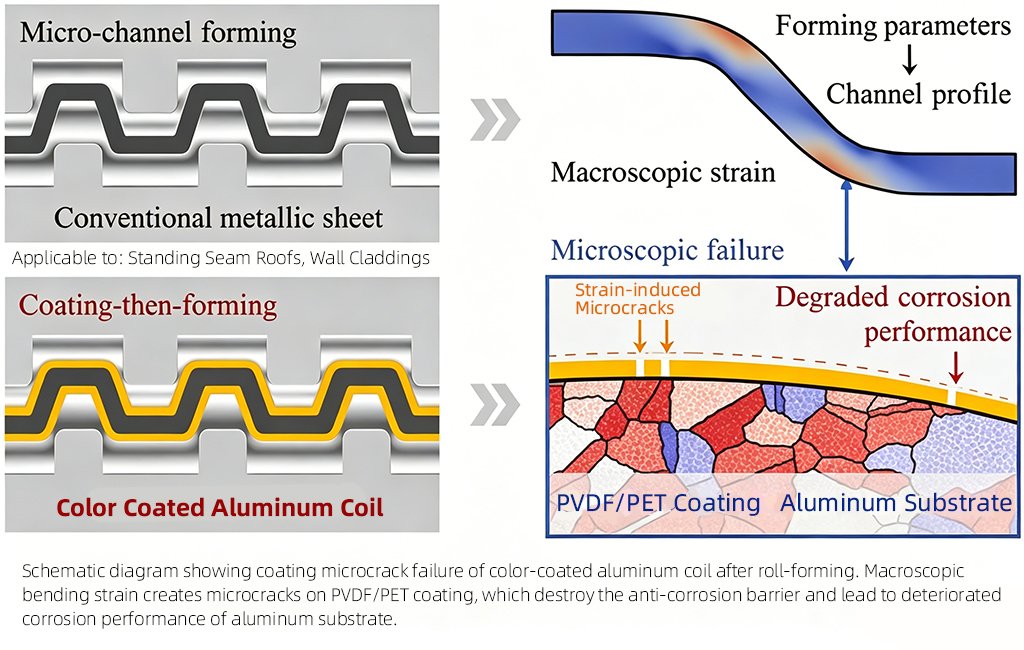
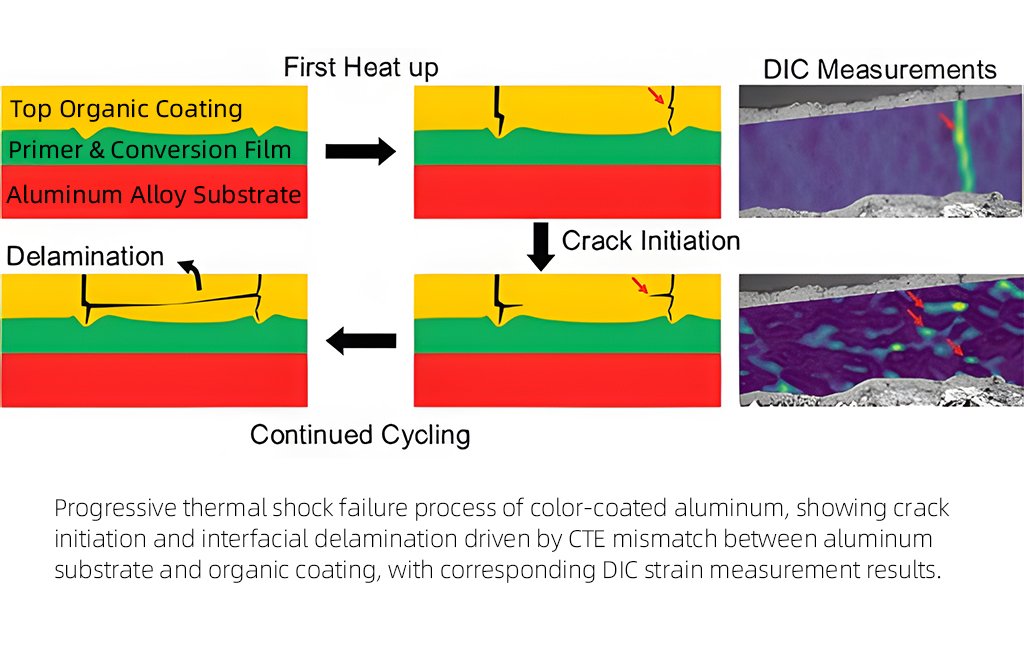
In high-heat, high-humidity tropical environments, this photo-oxidative degradation accelerates, leading to polymer chain scission, micro-cracking, and free radical formation. Clinically, this manifests as chalking (the liberation of unbound pigments like titanium dioxide) and fading (the destruction of pigment chromophores).
The rate of degradation is fundamentally determined by the chemical bond energy of the topcoat resin relative to the energy of incoming UV wavelengths.

Technical Parameter Comparison of Topcoat Chemistries
The table below outlines how different commercial topcoat chemistries perform under accelerated weathering and real-world tropical deployment when applied over standard architectural aluminum alloys (e.g., 3003-H14, 5052-H32).
| Performance Parameter | Polyester (PE) | Silicone Modified Polyester (SMP) | Polyvinylidene Fluoride (PVDF 70/30) | High-Durability Powder Coating (FEVE-based) |
| Primary Resin Chemistry | Hydroxyl-functional polyester | Silicone-interpolymerized polyester | 70% PVDF / 30% Acrylic blend | Fluoroethylene Vinyl Ether (FEVE) |
| Typical Coating Thickness | 15 – 20 μm | 20 – 25 μm | 25 – 30 μm (2-coat system) | 40 – 60 μm (Single/Dual coat) |
| UV Resistance Standard Compliance | Qualicoat Class 1 / AAMA 2603 | Qualicoat Class 2 / AAMA 2604 | Qualicoat Class 3 / AAMA 2605 | Qualicoat Class 3 / AAMA 2605-20 |
| Accelerated UV Testing (QUV-B 313nm) | Chalking/fading at < 500 hours | Chalking/fading at 1,000 – 1,500 hours | Minimal change after 3,000+ hours | Minimal change after 4,000+ hours |
| 10-Year Tropical Color Retention () | (High color shift) | (Moderate shift) | (Excellent retention) | (Superior retention) |
| Salt Spray Resistance (ASTM B117) | 500 – 1,000 hours | 1,000 – 1,500 hours | 3,000+ hours (with proper primer) | 3,000+ hours |
| Primary B2B Application Scenarios | Indoor partitioning, industrial warehouses | Residential roofing, agricultural buildings | Commercial skyscrapers, curtain walls, facades | Premium architectural profiles, marine infrastructure |
Molecular Breakdown of Topcoat Performance
Polyvinylidene Fluoride (PVDF) Performance
The exceptional UV-resistance of PVDF coatings stems from the molecular structure of the fluoropolymer. The Carbon-Fluorine (C-F) bond possesses a highly stable bond energy of approximately 485 kJ/mol. Because this energy threshold is significantly greater than the photon energy of UV radiation reaching the Earth’s surface (), the polymer chain resists photodissociation. In tropical zones, a 70/30 PVDF system maintains its gloss and resists chalking by preventing the oxidation of underlying pigments, retaining up to 85% of its original gloss after 10 years of South Florida or similar equatorial exposures.
Polyester (PE) and Silicone Modified Polyester (SMP) Performance
Standard Polyester (PE) coatings rely on Carbon-Oxygen (C-O) and Carbon-Carbon (C-C) bonds, which exhibit lower bond energies (). When subjected to the sustained UV-B flux of tropical climates, these bonds break down rapidly. This generates free radicals that react with atmospheric water vapor and oxygen, accelerating the degradation of the polymer matrix.
Silicone Modified Polyester (SMP) introduces a silicone intermediate resin containing Silicon-Oxygen (Si-O) bonds (). This chemical modification significantly increases UV resistance compared to standard PE. However, the polyester segments within the SMP matrix remain vulnerable to long-term tropical UV exposure, resulting in intermediate chalking performance over extended lifecycles.
High-Durability Powder Coatings (FEVE)
FEVE (Fluoroethylene Vinyl Ether) resins utilize a thermoset cross-linked structure that combines fluoropolymer segments with vinyl ether groups. The alternating structure protects the more vulnerable vinyl ether links from UV attack. When applied as a high-durability powder coating, the resulting film thickness () provides a robust physical barrier against the combined tropical stressors of UV radiation, high relative humidity, and airborne marine salts (coastal salinity).