
Architectural Durability: Why Coastal Buildings Require Three-Coat PVDF Aluminum Coils
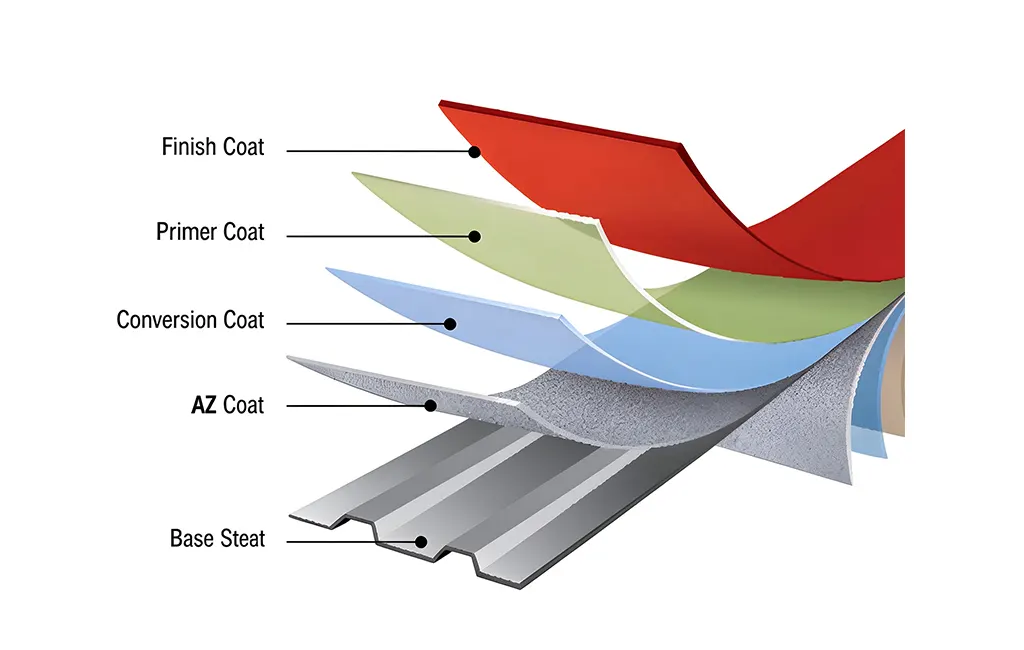
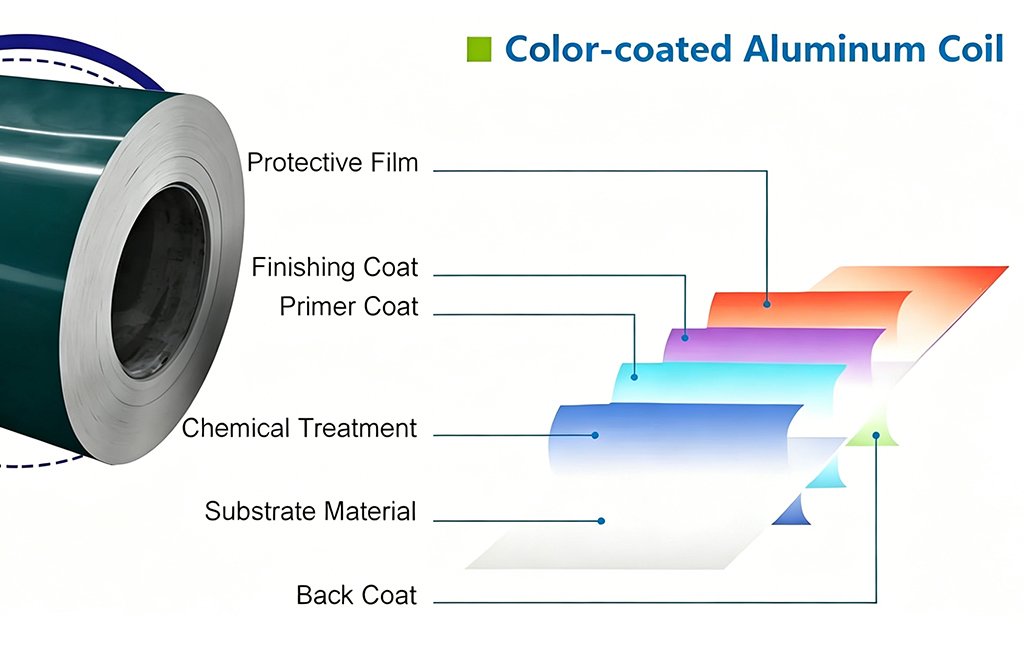
Coastal architectural environments expose building envelopes to a high-salinity, high-humidity atmosphere combined with intense ultraviolet (UV) radiation. Standard two-coat paint systems fail prematurely under these conditions due to accelerated chemical degradation and filiform corrosion. Coastal structures require Three-Coat Polyvinylidene Fluoride (PVDF) pre-coated aluminum coils to establish a robust, multilayered barrier. This system typically comprises a primer, a color basecoat, and a clear protective topcoat, achieving a total dry film thickness (DFT) of 35μm. This specific architectural configuration complies with international AAMA 2605 standards, ensuring long-term structural integrity, resistance to chloride-ion penetration, and color fastness.
Technical Performance Matrix: Coating Systems vs. Coastal Stressors
The following structural data matrix contrasts the performance profiles of various color-coated aluminum configurations under accelerated weathering and corrosive simulations.
| Technical Parameter | Three-Coat PVDF Aluminum Coil (Premium Coastal) | Two-Coat PVDF Aluminum Coil (Standard Exterior) | PE (Polyester) Color Aluminum (Inland Architectural) |
| Substrate Alloy Grade | AA3003, AA3004, AA5052 | AA3003, AA1100 | AA1100, AA3003 |
| Coating Layer Architecture | Primer + Basecoat + Clear Topcoat (3-Coat/3-Bake) | Primer + Basecoat (2-Coat/2-Bake) | Primer + Topcoat (2-Coat/2-Bake) |
| Total Coating Thickness (DFT) | 35 μm (Primer: 5μm; Base: 20-25μm; Clear: 10-15μm) | 25 μm 2μm | 15-20 μm |
| Salt Spray Resistance (ASTM B117) | 4,000 Hours (Blistering Size 8, Creepage 1mm) | 3,000 Hours | 1,000 Hours |
| UV Resistance (ASTM G154 / Delta E) | 5 after 4,000 Hours UV-B exposure | 5 after 3,000 Hours | 5 after 1,000 Hours |
| Chloride-Ion Permeability Rate | Highly Permeable | ||
| Gloss Retention (AAMA 2605) | 80% after 10 years real-world exposure | 50% after 10 years | 50% after 3 years |
| Primary Application Scenarios | Marine facades, coastal curtain walls, offshore roofing | Urban commercial facades, inland roofing | Interior panels, temporary signage, residential gutters |
Degradation Mechanism & The Three-Coat Mitigation Strategy
The Coastal Corrosion Threat Model
Coastal atmospheric environments are saturated with airborne sodium chloride () aerosols and moisture. Chloride ions possess a small ionic radius and high electronegativity, allowing them to readily penetrate porous organic coatings. Once these ions migrate to the aluminum substrate, they initiate galvanic macro-cells, causing localized pitting and filiform corrosion beneath the paint film. Furthermore, intense marine UV rays break down the carbon-fluorine () bonds within inferior binders, leading to polymer chalking and color fading.
How the Three-Coat Architecture Prevents Failure
The three-coat system forms an impenetrable barrier through a collaborative chemical architecture:
- The Primer Layer (5μm): Formulated with high-performance epoxy or polyurethane resins modified with corrosion-inhibiting passivating pigments. This layer cures directly on the conversion-coated aluminum, anchoring the system and preventing filiform corrosion creep if the coating is mechanically gouged.
- The Polyvinylidene Fluoride Basecoat (20-25μm): Composed of a minimum 70% PVDF fluoropolymer resin (e.g., Kynar 500 or Hylar 5000) blended with durable inorganic ceramic pigments. This layer provides the specified color and blocks the bulk of incoming UV radiation.
- The Clear PVDF Topcoat (10-15μm): A pure, unpigmented fluoropolymer resin layer. Because it contains no pigment particles to act as microscopic interfaces or sites for UV degradation, it functions as a continuous shield. It absorbs and scatters high-energy UV rays, encapsulates the basecoat pigments against oxygen and moisture, and prevents direct contact between corrosive chloride ions and the underlying color layer.
Case Study: Curtain Walls and High-Rise Façades
Commercial High-Rise Project (0-500m from Shoreline)
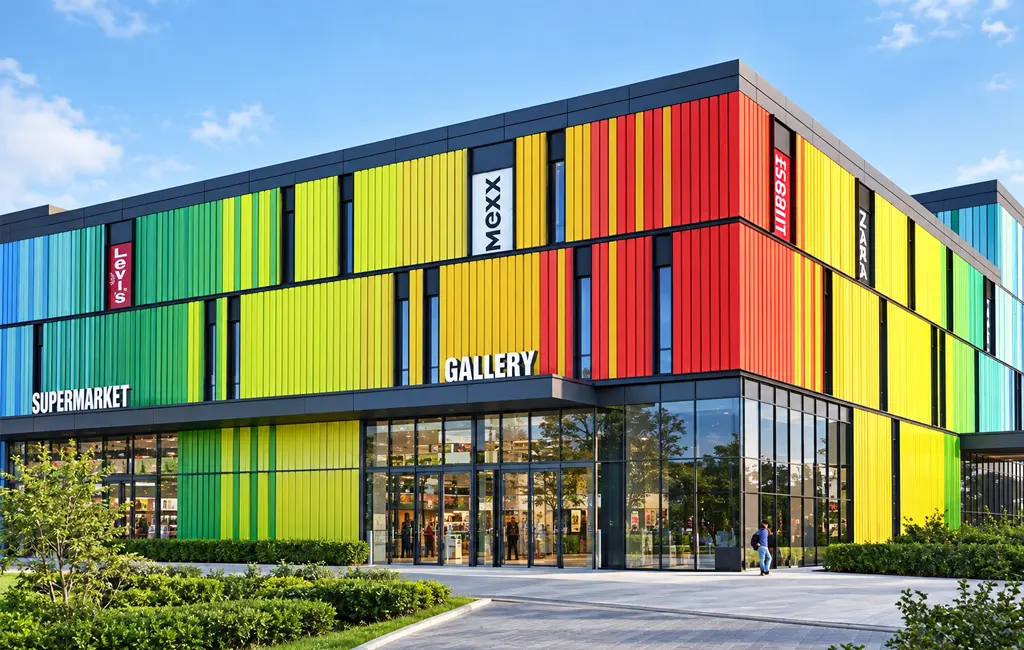
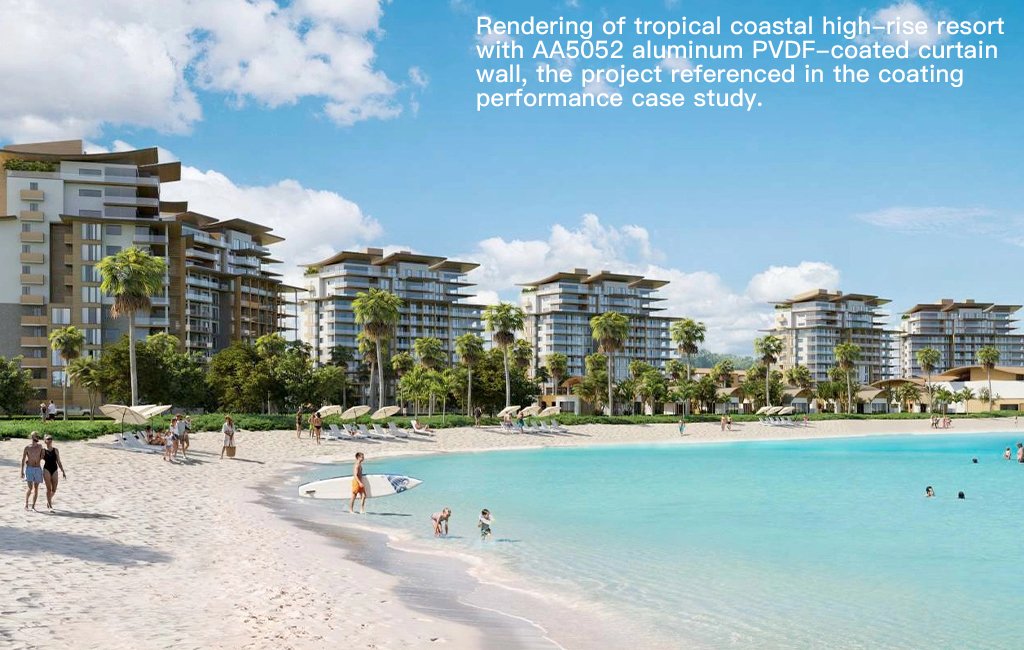
In a high-rise resort facade built directly on a tropical coastline, a standard two-coat PVDF system was substituted on a lower podium section, while the primary tower utilized a three-coat PVDF system on AA5052 aluminum panels.
Within 48 months, the two-coat panels exhibited a 35% drop in gloss retention and localized micro-blistering along the panel edges where salt spray accumulated. Conversely, the three-coat panels maintained a color variation () of less than 1.5 with zero signs of edge creep or filiform corrosion. The inclusion of the clear topcoat effectively reduced maintenance cycles from an annual high-pressure wash to a biannual rinse, yielding a 40% reduction in long-term operational expenditure (OpEx) over the building’s lifecycle.