
Strategic Selection of Color-Coated Aluminum Coils for C4/C5 Corrosive Environments
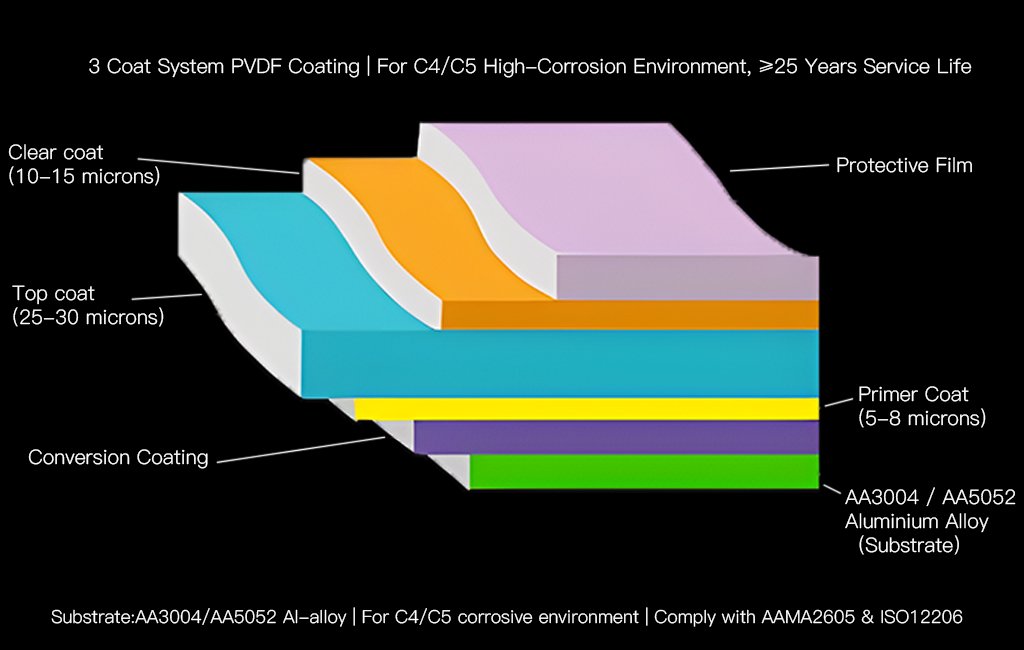
In highly corrosive C4 (industrial/chemical) and C5 (marine/seaside) environments, selecting color-coated aluminum coils requires balancing substrate metallurgy and coating chemistry. To ensure a service life exceeding 25 years, engineering specifications must mandate AA3004 or AA5052 manganese-magnesium aluminum alloys as the base metal due to their superior pitting resistance. The coating system must utilize a multi-layer Polyvinylidene Fluoride (PVDF) fluorocarbon system or a high-durability Thermoset Powder Coating, delivering a minimum total dry film thickness (DFT) of 25μm to 40μm. These configurations must strictly comply with AAMA 2605 and ISO 12206 international standards to withstand heavy industrial sulfur dioxide () emissions and marine chloride ion () attack.
Technical Performance Matrix for Corrosive Environments
The table below outlines the engineering specifications required for color-coated aluminum coils operating in severe industrial (C4) and marine (C5) atmospheres.
| Technical Parameter | Industrial / Chemical Plants (C4) | Marine / Seaside Locations (C5) |
| Recommended Alloy Grade | AA3004 (Al-Mn-Mg) / AA3105 | AA5052 (Al-Mg) / AA5754 |
| Coating Type Options | 3-Coat PVDF / FEVE Fluorocarbon | 2-Coat PVDF / High-Durability Powder Coating |
| Minimum Coating Thickness (DFT) | (Primer + Color + Clear) | (Primer + Topcoat) |
| Pre-treatment Standard | Multi-stage Chromate or Cr-free Chemical Conversion | Enhanced Zirconium/Titanium Silane Conversion |
| Salt Spray Resistance (ASTM B117) | (Film blistering ) | (Creepage from scribe ) |
| Acid/Alkali Resistance (ISO 2812) | 10% / 10% immersion for 240 hours: No blistering/peeling | 5% continuous immersion for 1000 hours: No degradation |
| UV Resistance (ASTM G154 / Delta E) | after 3,000 hours UV-A exposure | after 4,000 hours UV-B exposure |
| Gloss Retention Rate (AAMA 2605) | after 10-year field exposure | after 10-year field exposure |
Core Materials for Harsh Environments
PVDF Fluorocarbon Coated Color Aluminum
Polyvinylidene Fluoride (PVDF) coatings represent the benchmark for exterior building envelopes in chemical and marine sectors. The intrinsic electronegativity of the fluoropolymer structure gives the coil surface an exceptionally low surface energy. This property minimizes dirt accumulation and prevents chemical pollutants, such as nitrous oxides () and sulfurous compounds, from reacting with the coating.
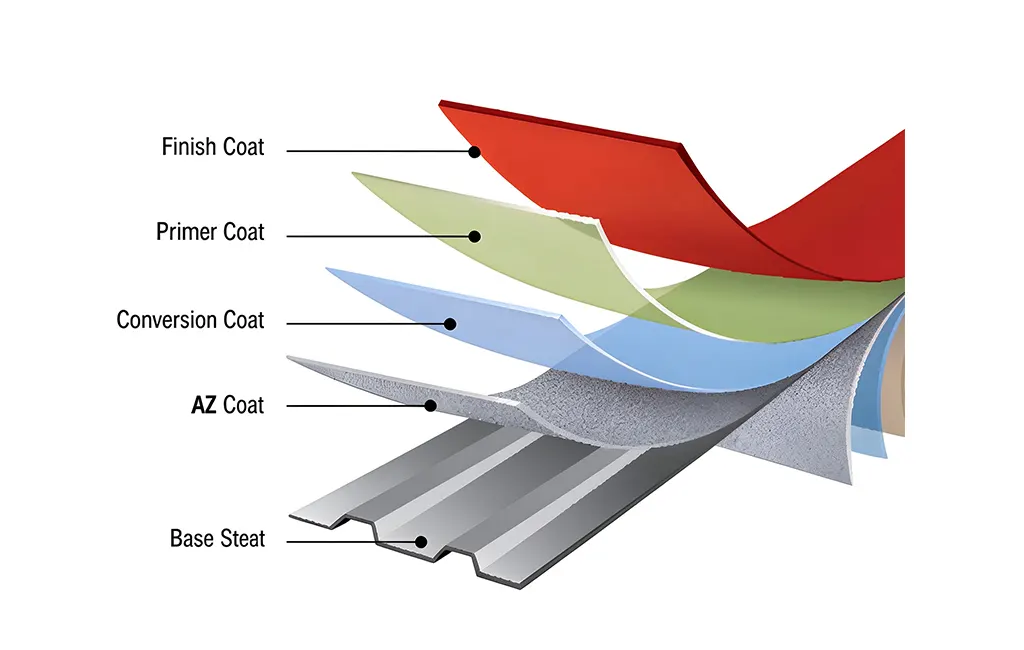
For chemical plants generating acidic exhaust, a 3-coat PVDF system (35μm) comprising a barrier primer, a fluoropolymer color coat, and a sacrificial clear topcoat provides the necessary barrier protection. This system limits oxygen and moisture diffusion to the aluminum substrate, maintaining structural integrity and color fastness.
Thermoset Powder Coated Color Aluminum
For industrial facilities prone to mechanical wear, particulate abrasion, or structural impact (e.g., port facilities and mining infrastructure), high-durability Thermoset Powder Coatings applied via automated electrostatic lines provide a robust alternative.
Engineered powder coatings—especially those utilizing super-durable polyester (SDP) or polyurethane chemistries applied at thicknesses of 60μm to 80μm—deliver superior scratch resistance and edge coverage compared to liquid coatings. When certified to ISO 12206 / Qualicoat Class 2 or Class 3 standards, these systems offer excellent corrosion barrier protection alongside high impact and abrasion resistance.
Addressing B2B Pain Points: Lifecycle Cost and Structural Integrity
Mitigating Filiform Corrosion in Coastal Zones
A primary failure mode for coated metal in marine environments is filiform corrosion—a localized, thread-like structural degradation that propagates beneath the paint layer when exposed to airborne chlorides and high relative humidity ().
By specifying AA5052-H32 aluminum alloys pre-treated with advanced conversion coatings, B2B buyers can prevent this sub-film corrosion. This protects the building’s aesthetic appearance and avoids structural failure of the underlying metal panels.