
Oven Zone Dynamics: Engineering Color Consistency and Pencil Hardness in Pre-Coated Aluminum
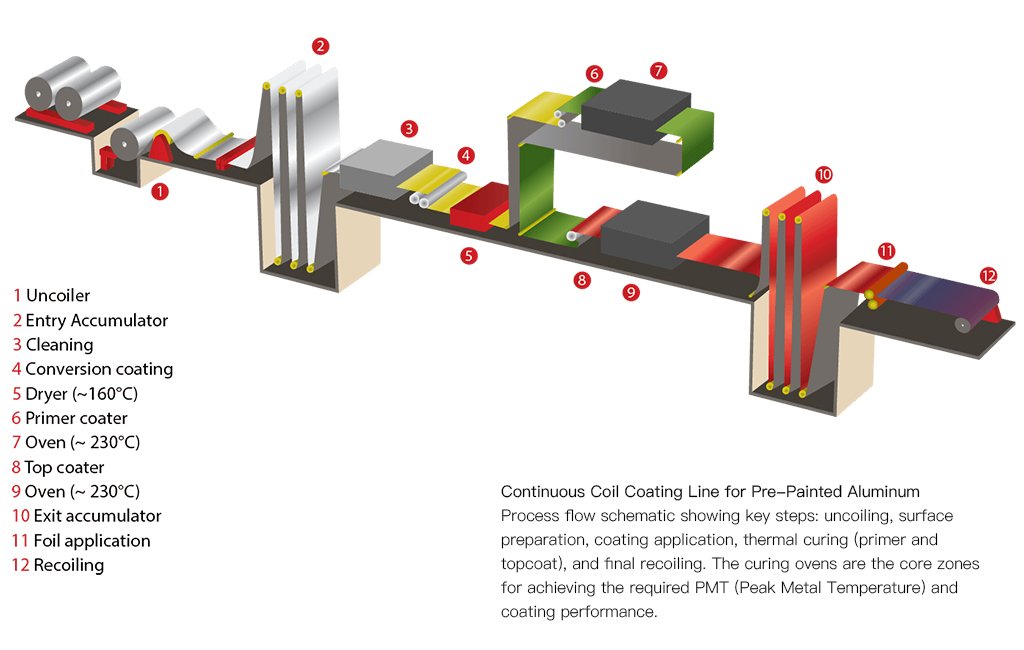
The thermal profile of the drying oven—divided into preheat, curing (PMT), and cooling zones—is the primary determinant of color consistency (Delta E ≤ 0.5) and pencil hardness (≥ 2H) in continuous coil coating. Each zone regulates a specific stage of solvent evaporation, polymer cross-linking, and structural stabilization. Precise control of the Peak Metal Temperature (PMT), typically between 241°C and 249°C for PVDF coatings, prevents defects like solvent popping, under-curing (soft coating), and over-curing (color shifting/brittleness). Balancing the Time-at-Temperature across these zones ensures uniform cross-link density and precise color fastness across the entire aluminum coil.
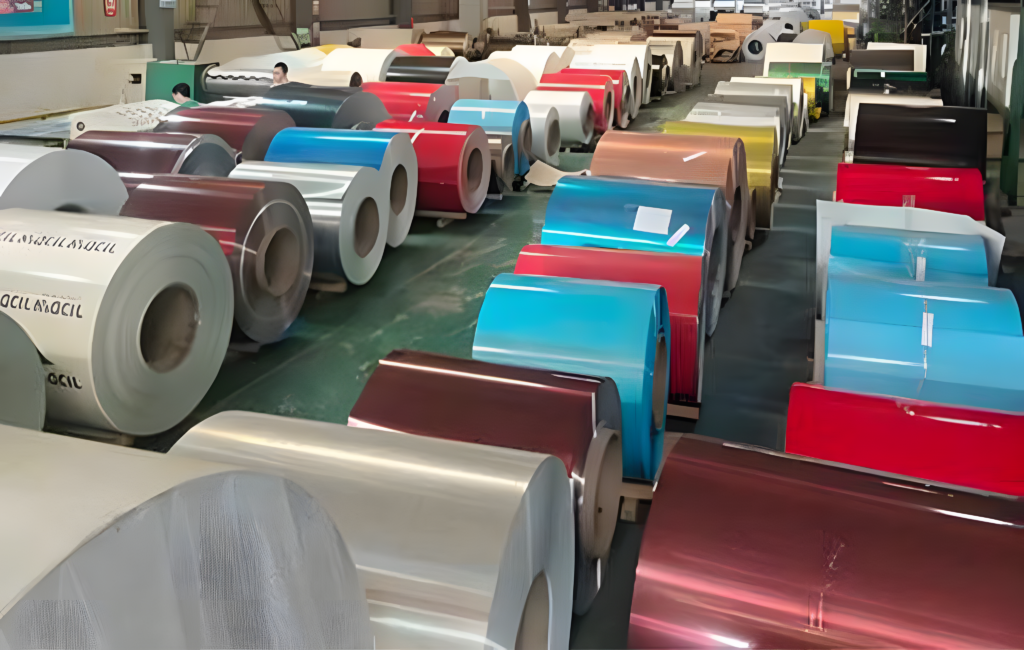
Technical Parameter Matrix: Thermal Profiling vs. Coating Performance
| Coating System Type | Preheat Zone Temp (°C) | Peak Metal Temp (PMT) Range (°C) | Cooling Zone Rate (°C/sec) | Target Pencil Hardness | Color Tolerance (ΔE Standard) | Primary Application Scenario |
| PVDF (70/30 resin) | 150 – 180 | 241 – 249 | ≥ 20 (Air + Water) | ≥ F – 2H | ≤0.5 (CIELAB) | High-end curtain walls, architectural facades (AAMA 2605) |
| High-Durability Polyester (HDP) | 130 – 160 | 232 – 243 | ≥15 (Air Quench) | ≥2H | ≤0.7 | Industrial roofing, roller shutters, cold storage panels |
| Super Durable Polyester (SDP) | 140 – 170 | 235 – 245 | ≥15 (Air Quench) | ≥2H | ≤0.6 | Commercial signage, exterior cladding |
| Polyurethane (PU / Polyamide) | 120 – 150 | 216 – 232 | ≥10 (Ambient Air) | ≥3H | ≤0.8 | Appliance housings, transport sector trim |
Micro-Zone Analysis: How Oven Phases Govern Coating Quality
1. The Preheat Zone: Solvent Flash-Off and Film Formation
The preheat zone initiates the thermal process by driving off volatile organic solvents (e.g., dibasic esters, aromatic hydrocarbons) from the liquid coating film.
- Impact on Color Consistency: If the temperature ramp-up is too aggressive, rapid solvent entrapment causes pinholing or blistering. This disrupts light refraction across the surface, resulting in visual color shifts and gloss variations.
- Impact on Hardness: Gradual heating ensures that the pigment particles settle uniformly within the resin matrix. Proper solvent evaporation sets a homogenous film density, which serves as the foundation for achieving uniform pencil hardness.
2. The Curing Zone: Polymer Cross-Linking and PMT Optimization
The curing zone is the critical metallurgical and chemical arena where the aluminum substrate reaches its specified Peak Metal Temperature (PMT).
- Impact on Color Consistency: Over-curing (exceeding the target PMT or prolonging resident time) triggers thermal degradation of the polymer matrix and organic pigments. This leads to yellowing, darkening, and a high color variance. Under-curing leaves pigments poorly bound, leading to poor color fastness and chalking under UV exposure.
- Impact on Hardness: This zone controls the cross-link density of the thermosetting or thermoplastic resins. For PVDF coatings, reaching a PMT of 241°C – 249°C guarantees that the fluoropolymer and acrylic resins fuse completely. If the PMT is missed by even 5 °C, the cross-linking remains incomplete, reducing film hardness below the required 2H standard and drastically weakening scratch resistance.
3. The Cooling Zone: Phase Stabilization and Crystallization
The cooling zone utilizes forced air followed by a water quench to abruptly halt the curing reaction and stabilize the coating.
- Impact on Color Consistency: Controlled, rapid cooling preserves the gloss and color distribution achieved in the curing zone. Slow, uneven cooling can cause differential crystallization in semi-crystalline resins like PVDF, creating localized haze or “mottling” that alters the perceived color uniformness.
- Impact on Hardness: Rapid quenching () locks the polymer chains into a dense, stable amorphous-crystalline equilibrium. This sudden thermal drop prevents the coating from remaining in a soft, thermoplastic state for too long, securing the final structural rigidity, film flexibility (T-bend performance ), and specified pencil hardness.