
The Technical Divergence: Residential vs. Structural Exterior Aluminum Coils
No, aluminum coils used for household appliances or interior applications are not the same as those engineered for building exterior walls. They differ fundamentally in alloy substrate chemistry, coating polymer technology, and dry film thickness (DFT).
Residential coils typically utilize low-strength alloys like AA1100 or AA1060 coated with a 15–20μm Polyester (PE) or Modified Polyester paint system. These are engineered for formability and cost-efficiency in controlled indoor environments.
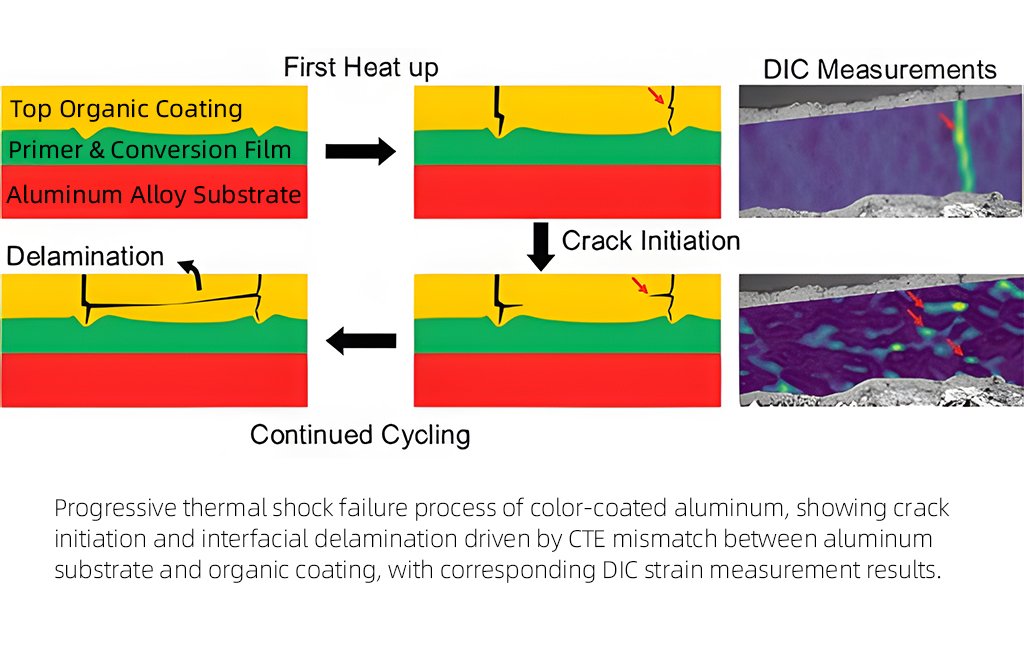
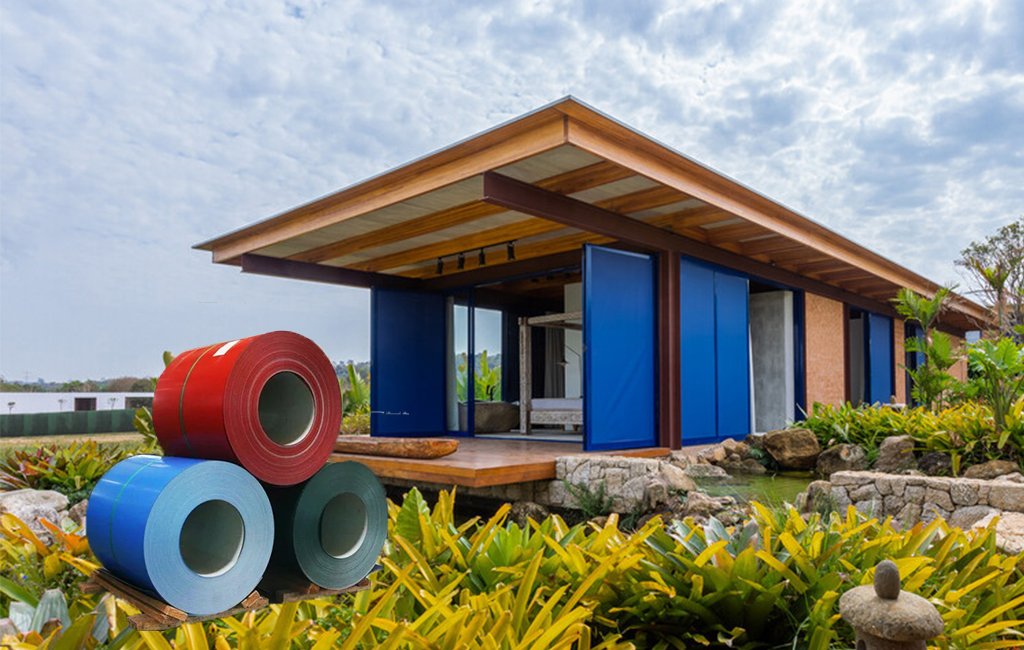
In contrast, structural exterior wall coils demand high-strength, corrosion-resistant alloys like AA3003, AA3004, or AA5052 coated with a 25μm Polyvinylidene Fluoride (PVDF) or architectural thermoset powder system. This heavier structural configuration is mandatory to withstand continuous ultraviolet (UV) radiation, thermal cycling, and atmospheric pollutants, ensuring compliance with strict building codes like AAMA 2605.
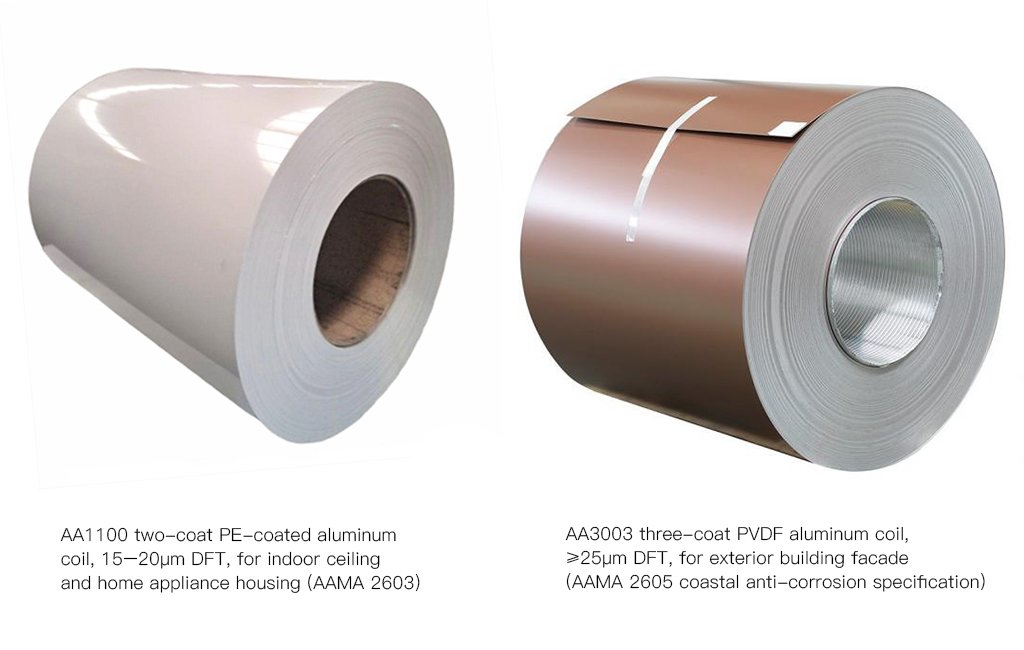
Technical Performance Matrix: Residential vs. Exterior Grade Aluminum Coils
The structural data matrix below details the sharp technical division between indoor/appliance-grade color aluminum and structural exterior-wall architectural configurations.
| Performance Parameter | Residential / Household Grade Coils | Architectural Exterior Wall Coils |
| Common Aluminum Alloys | AA1100, AA1060, AA8011 | AA3003, AA3004, AA5052, AA3105 |
| Alloy Temper State | H14, H24 (Focus on deep-drawing/stamping) | H14, H24, H44 (Focus on wind-load & yield strength) |
| Coating Chemical Base | Polyester (PE), Polyurethane (PU), Epoxy | 70% Kynar 500 / Hylar 5000 PVDF or FEVE |
| Coating Architecture | 1-Coat/1-Bake or 2-Coat/1-Bake | 2-Coat/2-Bake or 3-Coat/3-Bake |
| Dry Film Thickness (DFT) | 15μm – 20μm total system thickness | 25μm (Standard); 35μm (Coastal/Premium) |
| UV Resistance (ASTM G154) | Delta E (ΔE) ≤ 5 after 1,000 Hours | Delta E () ≤ 5 after 4,000 Hours |
| Salt Spray Testing (ASTM B117) | ≤ 500 Hours (Prone to blistering inland) | ≥ 3,000 to 4,000 Hours (Zero corrosion creep) |
| Gloss Retention (AAMA 2605) | Not rated; rapid chalking under direct sunlight | ≥ 80% retention after 10 years outdoor exposure |
| Primary B2B Applications | Refrigerator liners, microwave casings, indoor ceiling tiles | Curtain walls, commercial facades, metal roofing, composite panels (ACP) |
Performance Characteristics of Residential-Grade Coils
Formability and Surface Finish over Weatherability
Household color-coated aluminum coils prioritize mechanical flexibility and immediate aesthetic variety. Because appliances and interior fixtures undergo severe mechanical shaping—such as stamping, roll-forming, and deep-drawing—the coating binder must be highly elastic.
Why Polyester (PE) Binders Suit Indoor Scenarios
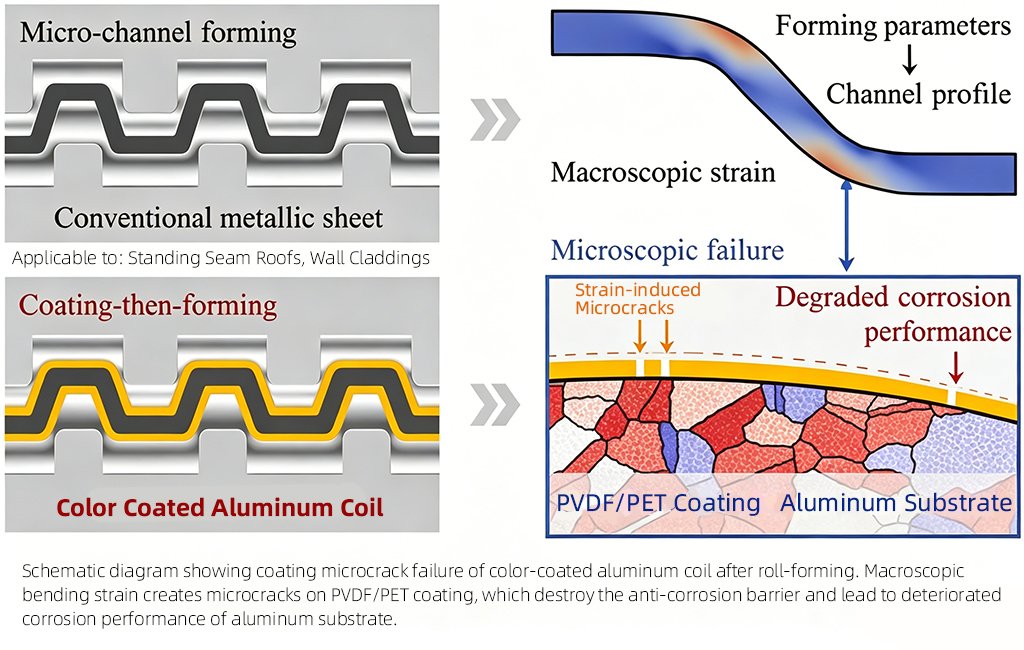
Linear Polyester (PE) coatings offer excellent flexibility (achieving a ≤ 1T bend rating) and high gloss availability at a lower price point. In climate-controlled interior environments, these coatings are isolated from moisture, acid rain, and UV wavelengths. Consequently, the low chemical resistance of the PE matrix is never exposed to the stressors that cause rapid color fading, chalking, and micro-cracking outdoors.
Performance Characteristics of Structural Exterior Wall Coils
Polymer Resistance to Environmental Factors
Exterior wall coils are heavily engineered structural elements designed to protect a building’s envelope for decades. The primary defense mechanism is the Polyvinylidene Fluoride (PVDF) molecular structure. The carbon-fluorine (C-F) bond within PVDF is one of the strongest known covalent bonds in chemistry, possessing a bond energy of approximately 485 kJ⋅mol−1.
The Structural Protection Layer
This high bond energy resists split-second photon attacks from UV radiation, preventing the polymer backbone from degrading. To complement this atomic strength, exterior architectural coils undergo a precise multi-stage pre-treatment process:
- Alkaline Degreasing & Acid Pickling: Cleans oxides and surface contaminants from the structural alloy.
- Chromate or Zirconium Conversion Coating: Chemically alters the aluminum surface into a passive layer, boosting paint adhesion and halting filiform corrosion.
- Inorganic Ceramic Pigmentation: Uses complex inorganic color pigments (instead of organic dyes) to ensure the facade achieves over 80% color fastness and gloss retention after 10 to 20 years of real-world exposure.