
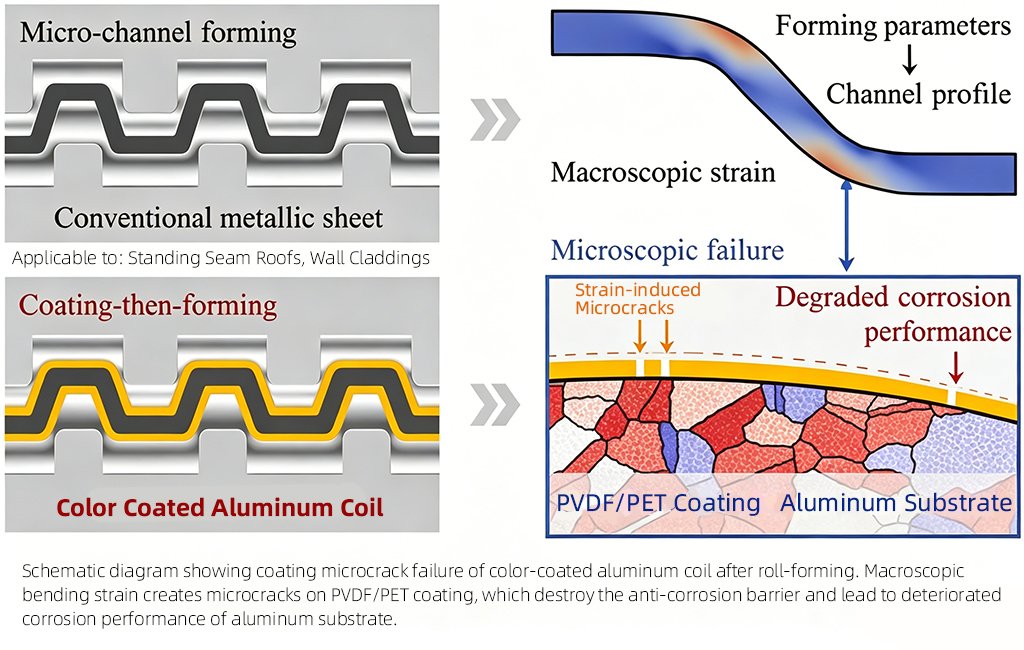
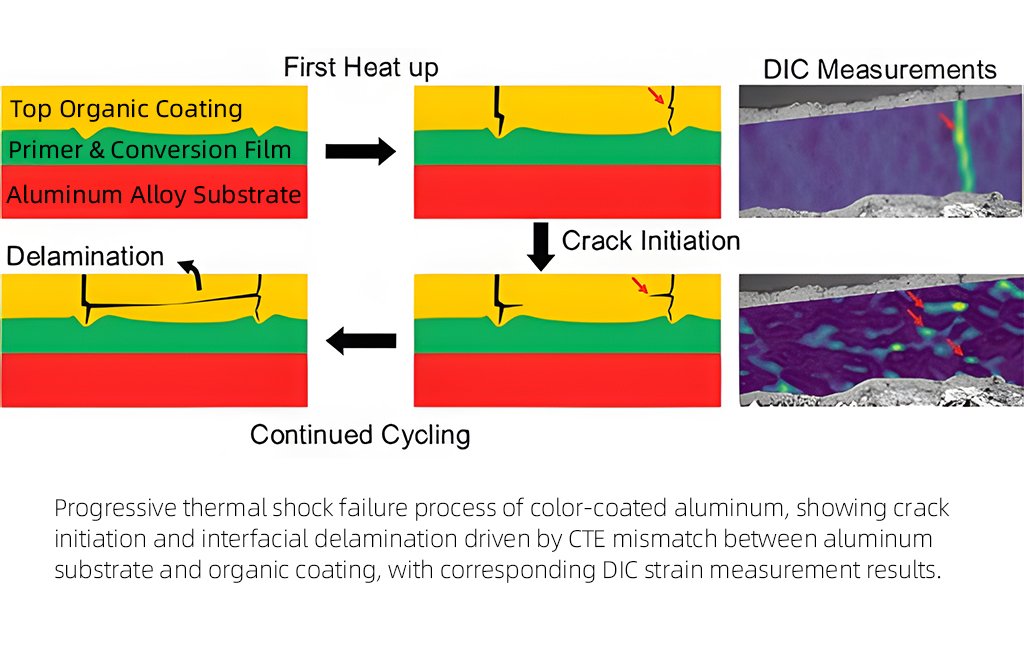
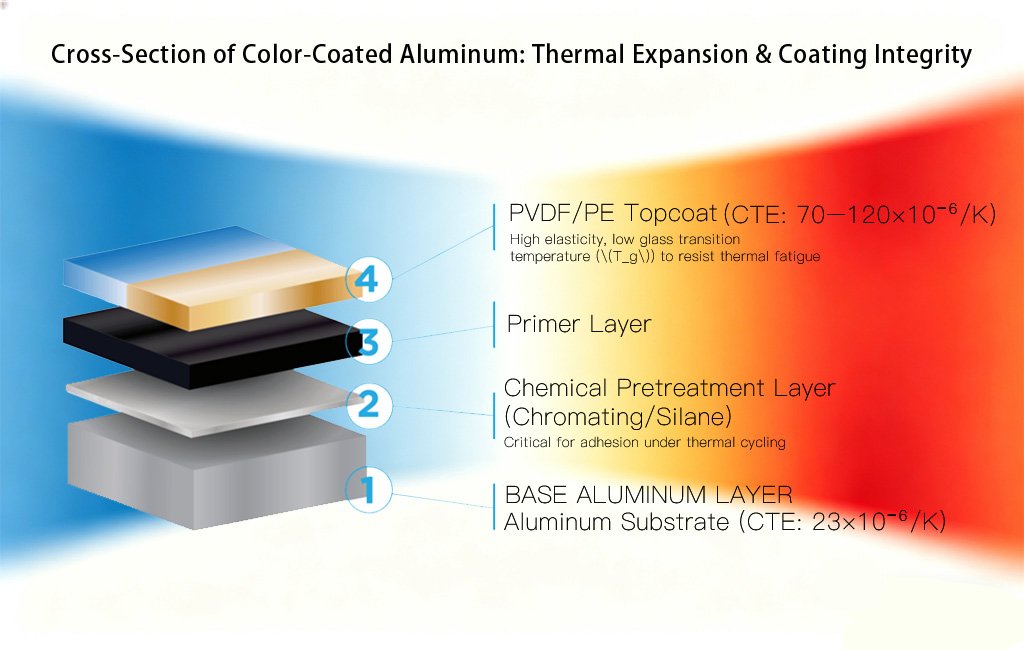
Thermal expansion and contraction impact coating integrity through the Coefficient of Thermal Expansion (CTE) mismatch between the aluminum substrate and the organic coating (typically PVDF or PE). Aluminum has a high CTE (approx. $23 \times 10^{-6}/K$), while polymer coatings expand at different rates. In temperature cycling environments, this creates interfacial shear stress. Repeated cycling can lead to micro-cracking (crazing), loss of interfacial adhesion, and eventually delamination. Maintaining integrity depends on the coating’s flexibility (T-bend rating) and the quality of the chemical pretreatment (chromating or silane), which ensures the bond can withstand the mechanical strain of substrate movement across operating ranges from -40°C to +80°C.
Technical Parameter Comparison: Coating Performance under Thermal Stress
The following matrix compares common color-coated aluminum systems and their resilience to thermal-induced mechanical fatigue.
| Parameter | PVDF (70% Kynar 500) | High-Durability Polyester (HDP) | PE (Polyester) |
| Aluminum Alloy Grade | 3003, 5052, 5754 | 1100, 3003 | 1000 Series, 3003 |
| CTE Compatibility | Excellent (High Elasticity) | Good | Moderate |
| Coating Thickness (μm) | 25 – 35 | 20 – 25 | 15 – 20 |
| T-Bend Flexibility | ≤ 2T (No Cracking) | ≤ 3T | ≤ 4T |
| Operating Temp Range | -50°C to +120°C | -30°C to +90°C | -20°C to +70°C |
| Adhesion (Cross-hatch) | Grade 0 (ISO 2409) | Grade 0-1 | Grade 1 |
| Gloss Retention (10 yrs) | >80% | >60% | >30% |
Mechanics of Interfacial Stress in Color Aluminum
The primary threat to color-coated aluminum in fluctuating climates is differential expansion. When a building facade is exposed to direct sunlight, the metal surface temperature can reach 80°C, causing the aluminum to expand significantly. At night, this temperature may drop to 10°C or lower.
The Role of Glass Transition Temperature ($T_g$)
The integrity of the coating is closely tied to its Glass Transition Temperature ($T_g$). If the environmental temperature drops below the $T_g$ of the polymer, the coating becomes “glassy” and brittle. In this state, the contraction of the aluminum substrate exerts a massive tensile force on the coating, leading to radial cracking. High-performance PVDF coatings are engineered with a lower $T_g$ to remain “rubbery” and flexible even in sub-zero temperatures, maintaining a tight molecular grip on the aluminum surface.
Industry Compliance: AAMA 2605 and Global Standards
To ensure long-term reliability in temperature-heavy environments, color-coated aluminum must adhere to international performance standards that simulate harsh atmospheric conditions:
- AAMA 2605-20: The “Gold Standard” for architectural coatings. It requires 4000 hours of salt spray resistance and 10 years of South Florida exposure testing, which inherently tests the coating’s ability to survive thousands of thermal cycles without chalking or peeling.
- ISO 12206: Specifies the requirements for powder coatings on aluminum for architectural purposes, emphasizing resistance to humid atmospheres containing sulfur dioxide, which can accelerate delamination if thermal cracks are present.
- Qualicoat/GSB International: These European standards mandate rigorous boiling water adhesion tests and pressure cooker tests to evaluate the hydrothermal stability of the bond—a key indicator of how the coating will behave when thermal expansion is coupled with moisture.