
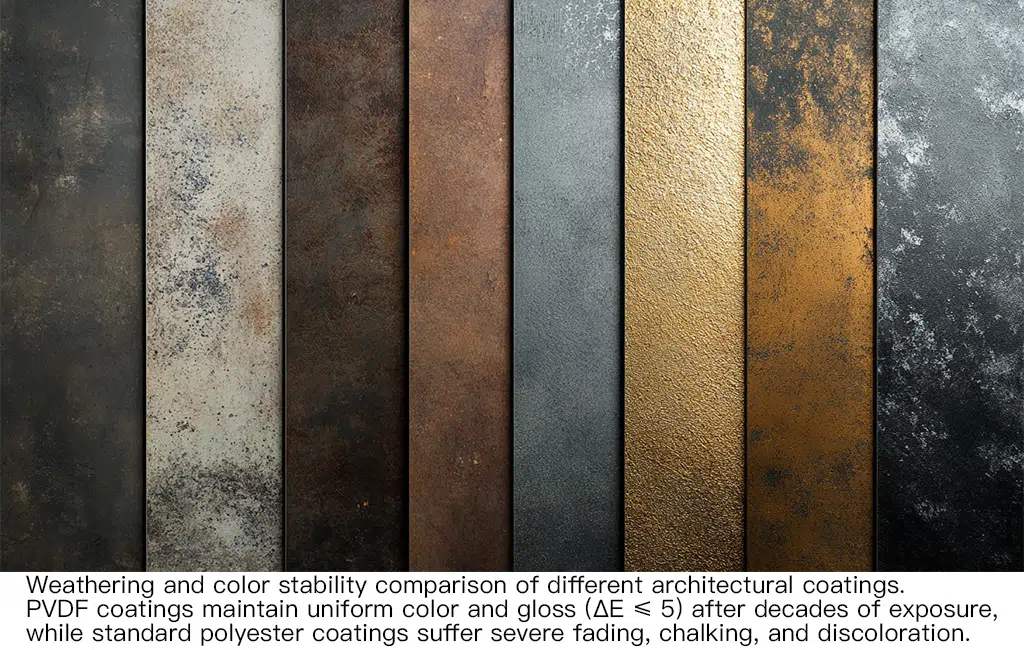


Multi-Layer Architecture of Pre-Coated Aluminum Coils
The coating structure of colored aluminum coils (pre-coated aluminum) typically consists of a multi-layer composite system applied via a continuous coil coating process. For high-performance exterior applications, a standard three-coat, two-bake (3C2B) or two-coat, two-bake (2C2B) system is utilized. The architecture comprises an aluminum alloy substrate (typically 3003 or 5052 series), a chemical conversion pre-treatment layer, a primer coat (5–7 μm), an architectural topcoat (15–20 μm PVDF or polyester), and an optional clear protective coat (5 μm). This engineering matrix optimizes interfacial adhesion, prevents filiform corrosion, and ensures long-term UV and weathering resistance.

Technical Parameter Matrix: Coating Systems and Substrate Performance
The table below outlines the structural and performance metrics of standard industrial color-coated aluminum configurations based on AAMA 2605 and ISO 12206 standards.
| Coating System Type | Substrate Alloy Grade | Layer Structure Configuration | Total Dry Film Thickness (DFT) | Salt Spray Resistance (ASTM B117) | UV Resistance / Color Retention (ΔE) | Primary B2B Application Scenario |
| Fluorocarbon (PVDF) 3-Coat | AA 5052 (Marine Grade) | Substrate + Pre-treatment + Primer + Topcoat + Clearcoat | ≥ 35 μm | ≥ 4,000 Hours | ΔE ≤ 5 after 10 years (AAMA 2605) | Coastal architectural curtain walls, high-pollution industrial roofing |
| Fluorocarbon (PVDF) 2-Coat | AA 3003 (Arch. Grade) | Substrate + Pre-treatment + Primer + Topcoat | ≥ 25 μm | ≥ 3,000 Hours | ΔE ≤ 5 after 10 years (AAMA 2605) | Commercial building facades, corporate identity signage |
| High-Durability Polyester (HDP) | AA 3003 / AA 1100 | Substrate + Pre-treatment + Primer + HDP Topcoat | ≥ 20 μm | ≥ 1,500 Hours | ΔE ≤ 5 after 5 years (GB/T 5237.5) | Industrial warehouses, residential roofing, gutter systems |
| Thermoset Powder Coating | AA 6063 / AA 5052 | Substrate + Pre-treatment + Single/Double Powder Layer | 60 – 120 μm | ≥ 3,000 Hours | Variable by powder chemistry | Heavy-duty architectural extrusions, premium window frames |
Layer-by-Layer Functional Analysis of Color Aluminum
1. Aluminum Alloy Substrate
- Composition: Typically AA 3003 (Al-Mn) for general architectural forming or AA 5052 (Al-Mg) for structural, high-strength, and marine environments.
- Function: Acts as the load-bearing core. It dictates the structural mechanical properties, including tensile strength, yield strength, and elongation (formability) required during post-coating roll-forming or stamping.
2. Chemical Conversion Pre-treatment Layer
- Composition: Chromate, phosphate, or modern titanium/zirconium-based chromate-free conversion coatings.
- Function: Removes natural, unstable aluminum oxides through degreasing and acid/alkaline etching, replacing them with a uniform microscopic conversion layer. This layer dramatically increases surface free energy to maximize primer mechanical interlocking and provides secondary passivation against filiform corrosion.
3. Anti-Corrosive Primer Coat
- Composition: Polyurethane (PU) or Epoxy resin matrices modified with corrosion-inhibiting pigments (e.g., strontium chromate or zinc phosphate alternatives).
- Thickness: Configured strictly to 5–7 μm.
- Function: Serves a dual-purpose engineering role. First, it establishes chemical cross-linking bonds with both the conversion layer and the topcoat, preventing delamination. Second, it acts as a sacrificial barrier that blocks moisture and chloride ions from migrating to the substrate.
4. Primary Topcoat (Color Coat)
- Composition: Formulated using Fluoropolymer resins containing 70% Polyvinylidene Fluoride (PVDF) combined with 30% acrylic resins, or alternative high-performance polymers like High-Durability Polyester (HDP). It utilizes inorganic ceramic metal oxide pigments for color fastness.
- Thickness: Configured to 15–20 μm.
- Function: The primary line of defense against environmental degradation. The strong chemical bonds of the carbon-fluorine (C-F) molecular structure within PVDF provide unmatched resistance to ultraviolet (UV) radiation (preventing chalking and color fading) and resistance to chemical attacks from acid rain and industrial pollutants.
5. Clear Protective Topcoat (Three-Coat Systems Only)
- Composition: Unpigmented, 100% pure fluoropolymer (PVDF) liquid resin.
- Thickness: Configured to ≥ 5 μm.
- Function: Adds an extra barrier layer that shields the pigment particles in the topcoat from atmospheric oxygen and UV exposure. It enhances gloss retention, improves scratch resistance during handling, and protects metallic/mica flake pigments from oxidation.
6. Service Backer Coat (Reverse Side)
- Composition: Single-layer Epoxy or Polyester (PE) resin system.
- Thickness: Configured to 5–8 μm.
- Function: Protects the reverse side of the coil against mechanical abrasion and “roll-rub” damage during high-speed coiling and transit. It also provides corrosion protection for interior exposures and serves as a compatible bonding surface for polyurethane insulation foaming in sandwich panel manufacturing.
