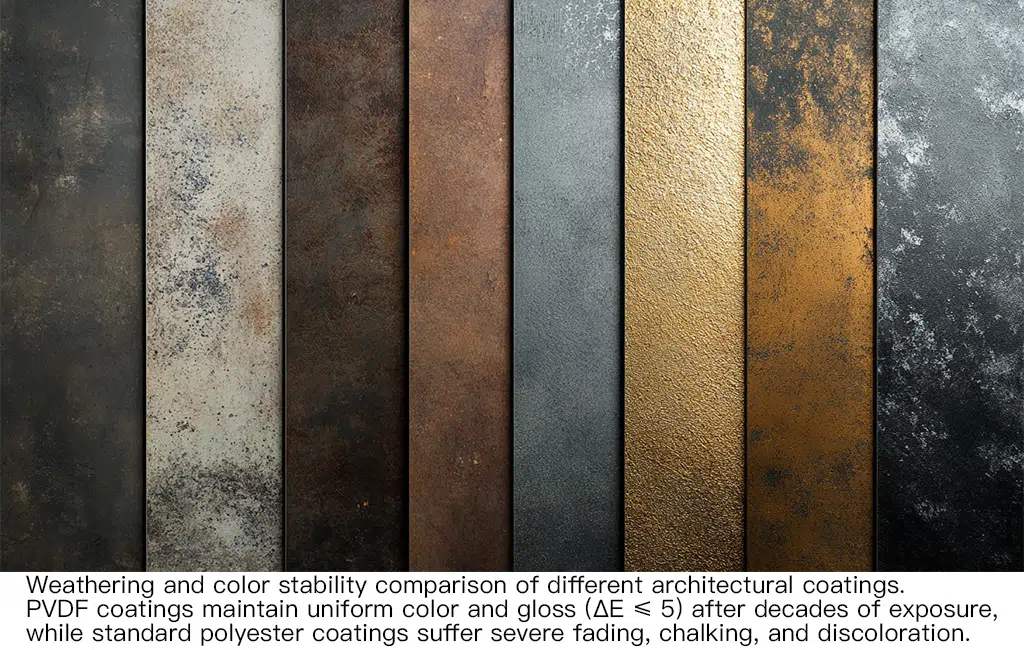


Photo-Chemical Mechanism of PVDF Coating Solar Resistance
PVDF (Polyvinylidene Fluoride) fluorocarbon-coated aluminum coils exhibit superior solar and UV resistance due to the exceptionally high bond dissociation energy of the carbon-fluorine (C-F) bond, which reaches approximately 485 kJ/mol. Solar ultraviolet radiation, particularly UV-A and UV-B spectra, spans wavelengths from 290 to 400 nm, carrying photon energies between 300 and 411 kJ/mol. Because the C-F molecular bond energy exceeds the maximum photon energy of natural terrestrial UV radiation, the polymer matrix resists chemical bond cleavage, photo-oxidation, and polymer degradation. This quantum-level stability prevents film chalking, cracking, and pigment exposure, allowing the coating to maintain its structural integrity under prolonged solar irradiance.
Technical Parameter Matrix: Solar and Weathering Performance Specifications
The table below provides a comparative analysis of PVDF coatings against other standard industrial color aluminum chemistries under accelerated weathering and thermal testing protocols.
| Performance Parameter | 70% PVDF Fluorocarbon Coating | High-Durability Polyester (HDP) | Standard Polyester (PE) | Thermoset Powder Coating |
| Primary Resin Chemistry | 70% Polyvinylidene Fluoride / 30% Acrylic | Modified Saturated Polyester | High-Molecular Weight Polyester | Triglycidyl Isocyanurate (TGIC) / Polyurethane |
| UV Resistance Standard Compliance | AAMA 2605-20 (Excellent) | AAMA 2604 (High) | AAMA 2603 (Standard) | AAMA 2604 / AAMA 2605 (Variable) |
| QUV Accelerated Weathering (ASTM G154) | ≥ 5,000 Hours (Gloss Retention ≥ 80%) | ≥ 3,000 Hours (Gloss Retention ≥ 60%) | ≥ 1,000 Hours (Gloss Retention ≥ 50%) | ≥ 3,000 to 4,000 Hours |
| Color Retention Rate ($\Delta E$ after 10 Years) | Delta E ≤ 5.0 units (ASTM D2244) | Delta E ≤ 5.0 units (after 5 years) | Delta E ≤ 5.0 units (after 2-3 years) | Delta E ≤ 5.0 units (after 5-10 years) |
| Chalking Resistance (ASTM D4214) | Rating ≥ 8 (Max Resistance) | Rating ≥ 6 | Rating ≥ 4 | Rating ≥ 7 |
| Max Continuous Operating Temp | 150°C | 120°C | 90°C | 100°C to 120°C |
| Primary High-Solar Scenarios | Desert facades, high-rise curtain walls, roofing | Industrial cladding, gutters | Indoor paneling, signage | Architectural extrusions, frames |
Atomic Mechanisms of PVDF Solar Superiority
The Carbon-Fluorine (C-F) Molecular Shield
The core driver of PVDF’s solar resistance is its molecular architecture, consisting of alternating CH₂ and CF₂ groups. Fluorine is the most electronegative element, which creates an extremely tight, short, and highly polarized covalent bond with carbon.

Polymer Degradation Threshold: The covalent bond energy of 485 kJ/mol makes the polymer backbone inert to the ionizing energy of terrestrial UV light (300–411 kJ/mol). Instead of breaking down and undergoing chain scission, the PVDF film dissipates the absorbed solar energy as heat without altering its chemical structure.
Chemical Inertness and Environmental Synergy
Solar radiation accelerates chemical oxidation and acid rain degradation on building facades. Because the fluorine atoms completely envelope the carbon backbone, they form a protective steric hindrance shield. This shield prevents atmospheric radicals, ozone (O₃), and industrial sulfur dioxide (SO₂) from attacking the polymer chain, neutralizing the synergistic degradation effect of combined heat, moisture, and sunlight.
Core Components of a High-Solar PVDF Coating System
70% Kynar 500 / Hylar 5000 Resin Base
A true solar-resistant coating requires a specialized resin blend formulation. Industry standards mandate a 70:30 ratio of fluoropolymer to acrylic resin. The 70% PVDF component delivers the foundational UV inertness and weatherability, while the 30% acrylic component is technically necessary to dissolve the pigments, improve film flexibility, and enhance mechanical adhesion to the underlying primer.
Inorganic Ceramic Metal Oxide Pigments
Even a UV-stable resin will fail if the coloring agents fade. High-solar PVDF coatings exclude organic dyes, utilizing only Inorganic Mixed Metal Oxide (MMO) pigments (such as cobalt aluminates, titanium dioxides, and copper chromites). These pigments are synthesized at temperatures exceeding 800°C, making them completely stable against solar-induced photo-reduction and ensuring a color retention rate where Delta E ≤ 5.0 over a 10-year outdoor exposure cycle.
B2B Value Propositions: Mitigating Lifecycle Costs via PVDF
For global procurement managers, structural engineers, and facade fabricators, specifying PVDF-coated aluminum coils directly solves critical economic and field performance issues:
- Minimizing Maintenance and Recoating Costs: Standard polyester panels installed in high-solar zones (like Latin America or Central Asia) require replacement or field recoating within 5 to 7 years due to severe chalking and fading. PVDF coatings retain over 80% of their original gloss after 10 years, extending the building maintenance cycle to 20+ years.
- Preventing Structural Thermal Stress: High-solar environments cause severe heat absorption on building skins, inducing thermal expansion and contraction cycles that crack coatings. PVDF coatings mixed with “cool roof” infrared-reflective pigments reflect up to 70% of solar heat energy, lowering the surface temperature of aluminum curtain walls and preventing micro-cracking at stress points.
- Guaranteeing Aesthetic Uniformity across Facades: Buildings experience uneven solar exposure depending on orientation (e.g., south-facing walls receive maximum UV load). PVDF’s low fading rate (Delta E ≤ 5) ensures that shaded areas and highly exposed zones maintain a uniform color match over decades, preserving corporate identity and asset valuation.