

No, Excessive Dry Film Thickness (DFT) Compromises Performance
In pre-coated aluminum coil manufacturing, a higher Dry Film Thickness (DFT) is not universally superior. While an optimal DFT enhances UV resistance and corrosion protection, excessive coating thickness introduces severe engineering liabilities. Specifying DFT beyond recommended parameters—such as exceeding 25–35μm for a standard two-coat PVDF system or 60–80μm for powder-coated surfaces—compromises the mechanical integrity of the composite material.
Crucially, over-application reduces the coating’s T-bend flexibility, leading to micro-cracking and delamination during subsequent roll-forming or stamping processes. Furthermore, excessively thick wet films trap solvents during the flash-off phase, causing pinholing, blistering, and sub-surface porosity during high-temperature curing (240℃ – 260℃ Peak Metal Temperature/PMT). Therefore, DFT must be precision-engineered based on alloy grade, coating chemistry, and final application constraints rather than maximized indiscriminately.
Technical Parameter Matrix: Coating Systems vs. Performance Metrics
The table below outlines how varying coating chemistries and their specified DFTs impact mechanical performance and environmental resistance across common aluminum alloy substrates.
| Coating Type | Substrate Alloy Grade | Standard DFT Range (μm) | T-Bend Flexibility (ASTM D4145) | Salt Spray Resistance (ASTM B117) | UV Resistance / Color Retention (ΔE) | Primary B2B Application |
| PVDF (Polyvinylidene Fluoride – 2 Coat) | AA3003 / AA3105 | 23 – 28 | ≤ 1T (No cracking) | ≥ 3,000 hrs | ΔE ≤ 5 over 10 years | Commercial architectural curtain walls, metal roofing |
| PVDF (3-Coat Ultra-Durable) | AA5052 (Marine Grade) | 35 – 45 | ≤ 2T (No delamination) | ≥ 4,000 hrs | ΔE ≤ 3 over 15 years | Coastal infrastructure, industrial chemical plants |
| FEVE (Fluoroethylene Vinyl Ether) | AA3003 / AA5052 | 25 – 30 | ≤ 2T | ≥ 3,000 hrs | High gloss retention (>80% after 10 yrs) | Corporate branding signage, high-gloss facades |
| HDP (High-Durable Polyester) | AA1100 / AA3003 | 20 – 25 | ≤ 1T | ≥ 1,000 hrs | ΔE ≤ 5 over 5 years | Residential gutters, rolling shutters, appliances |
| PE (Standard Polyester) | AA1100 / AA3105 | 15 – 20 | ≤ 0T – 1T | ≥ 500 hrs | Indoor degradation variance | Interior ceiling panels, composite board liners |
Mechanical and Chemical Risks of Excessive DFT
Impact on Formability and T-Bend Flexibility
When aluminum coils undergo high-speed roll forming to produce profiles like standing-seam roofing, the coating experiences intense tensile and compressive stresses. Polymeric coatings have an inherent elongation limit.
When the DFT is too high, the neutral axis of stress shifts during bending, generating extreme tensile stress on the outer surface of the coating. This results in macro-cracking, crazing, and localized delamination. This failure mechanism destroys the barrier protection, leaving the underlying AA3003 or AA5052 aluminum exposed to atmospheric moisture.
Solvent Entrapment and Sub-Surface Porosity
During the continuous coil coating process, wet films pass through multi-zone convection ovens. If the wet film thickness is excessive, the outer surface cures and forms a “skin” before the lower-level solvents can evaporate. These trapped volatile organic compounds (VOCs) eventually vaporize, breaking through the semi-solid surface layer. This creates micro-pores, pinholes, and blistering that severely degrade the long-term weatherability of the coil, causing premature chalking and color fading.

Optimizing DFT for Harsh Environments: The Architectural Perspective
Meeting AAMA 2605 Standards for Exterior Facades
In highly corrosive or high-UV environments (such as industrial zones or tropical coastal areas), increasing protection should be achieved through advanced multi-coat chemistry, not by applying a thicker single layer. For instance, AAMA 2605-20 specifies the performance metrics required for high-performance architectural coatings.
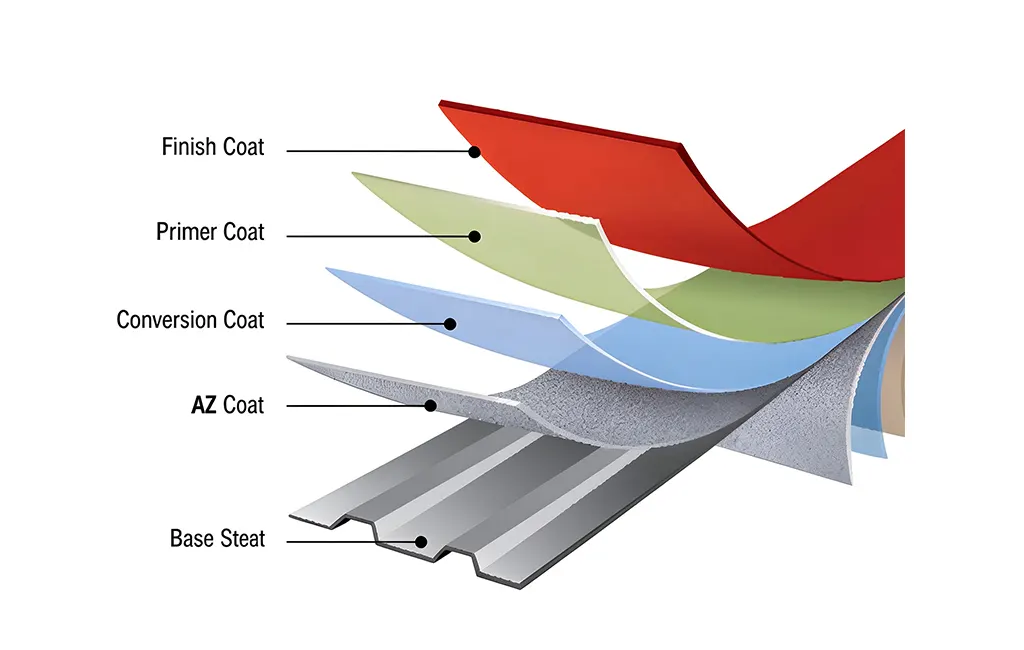
To safely achieve a higher total DFT for severe exposures, engineers deploy a three-coat or four-coat system consisting of:
- A corrosion-inhibiting polyurethane or epoxy primer (5-7 μm)
- A highly pigmented PVDF basecoat (20-25 μm)
- A protective PVDF clear topcoat (10-15 μm)
This layered configuration optimizes cross-linking density, preserves mechanical flexibility, and delivers a salt spray resistance exceeding 4,000 hours without sacrificing coil formability.
