

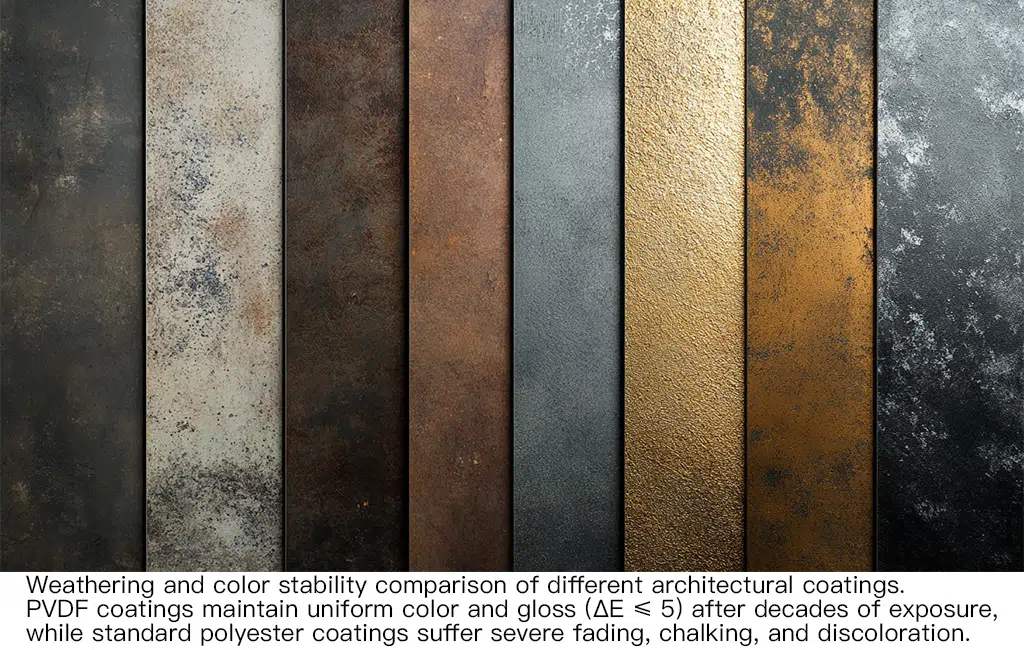

The Salt Spray Test for Color-Coated Aluminum Coils: Core Metrics
The salt spray test (specifically ASTM B117 or ISO 9227) for color-coated aluminum coils measures the corrosive undercut resistance, coating adhesion, and filiform corrosion susceptibility of the prepainted aluminum system. By exposing the specimen to a continuous, atomized 5% sodium chloride (NaCl) solution at a controlled temperature of 35°C, the test accelerates the electrochemical oxidation of the underlying aluminum substrate. It quantifies how effectively the pre-treatment layer (e.g., chromate or non-chromate conversion coating) and the organic topcoat (PVDF, PE, or PUR-PA) prevent moisture and chloride ions from penetrating the paint-metal interface, thereby predicting long-term atmospheric durability in coastal and industrial environments.
Technical Performance Matrix: Coating Degradation & Corrosion Resistance
The table below outlines how different color-coated aluminum specifications perform under accelerated corrosion testing and their corresponding structural metrics.
| Aluminum Alloy Grade | Coating Type | Pre-Treatment Type | Topcoat Thickness (μm) | Neutral Salt Spray (NSS) Resistance (Hours) | Blistering / Undercut Rating (ASTM D1654) | Primary B2B Application Scenario |
| AA 3003 / 3105 | Regular Modified Polyester (PE) | Non-Chromate Conversion | 15 – 20 | ≥ 500 | ≤ 2 mm creepage from scribe | Residential roofing, interior wall cladding |
| AA 3003 / 3004 | High-Durability Polyester (HDP) | Chromate Conversion | 20 – 25 | ≥ 1,000 | ≤ 1 mm creepage from scribe | Industrial roofing, warehouse facades |
| AA 5052 / 5754 | Polyvinylidene Fluoride (PVDF 70/30) | Multi-Layer Chromate | 25 – 35 | ≥ 3,000 | 0 mm (No creepage/blistering) | Coastal architecture, curtain walls, marine trim |
| AA 6061 / 5052 | Polyurethane-Polyamide (PUR-PA) | Anodized + Conversion | 30 – 40 | ≥ 2,000 | ≤ 0.5 mm creepage | Heavy industrial zones, chemical processing plants |
Failure Modes Evaluated by Salt Spray Testing
Filiform Corrosion Resistance
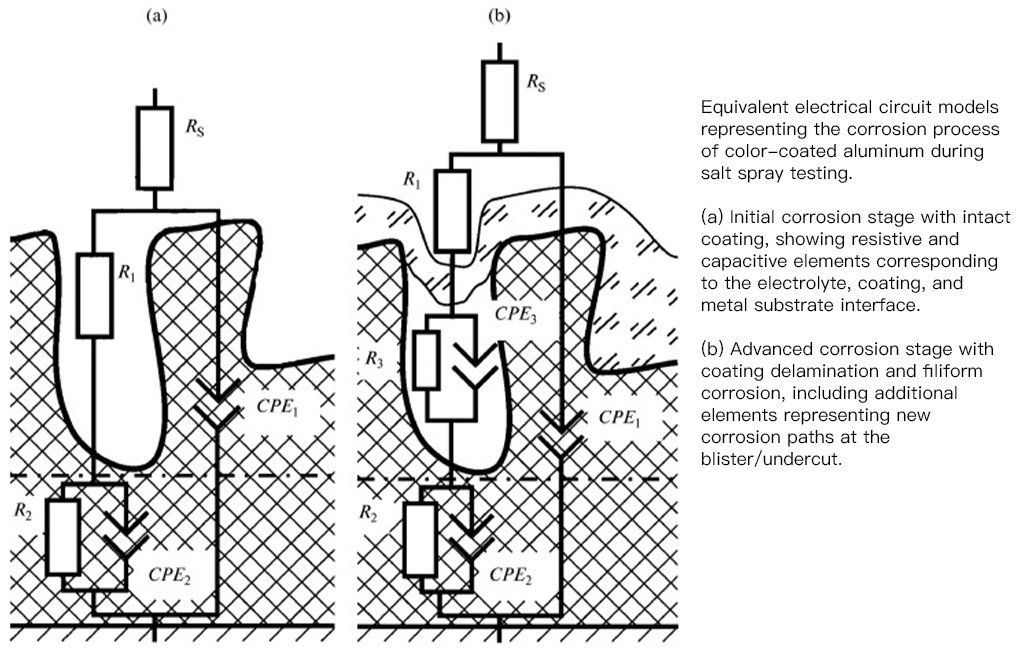
For color-coated aluminum coils deployed in humid, coastal environments, filiform corrosion represents a catastrophic structural risk. This localized, thread-like corrosion occurs beneath the organic coating when moisture and chlorides penetrate a microscopic defect. The salt spray test, often followed by a humidity cycle (ISO 4623-2), evaluates how effectively the pre-treatment chemistry passivates the aluminum substrate to arrest this filamentary growth.
Coating-Substrate Adhesion Degradation
The continuous exposure to hot, atomized brine breaks down secondary molecular bonds between the primer coat and the metal substrate. By evaluating the panel post-test via cross-hatch tape adhesion (ASTM D3359), engineers can verify if the interlayer adhesion can withstand extreme osmotic pressure without peeling or delaminating.