
Impact of Iron and Silicon Impurities on Color-Coated Aluminum Coils
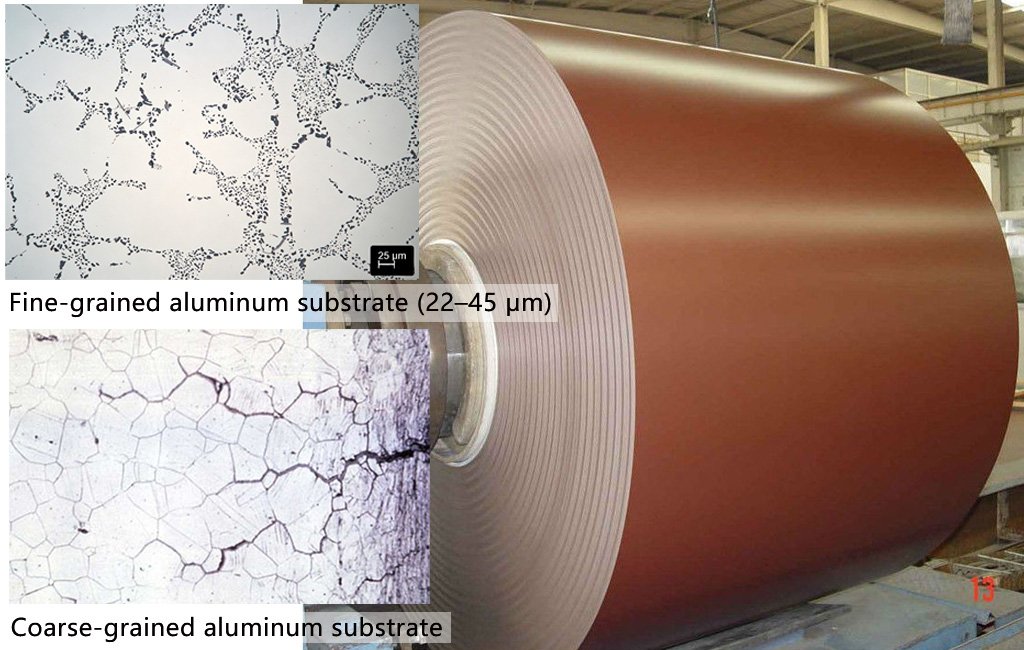
Impurities like iron (Fe) and silicon (Si) in aluminum alloy substrates—typically 3000 series (Al-Mn) or 5000 series (Al-Mg)—critically accelerate the degradation of color-coated coils in outdoor environments. High iron content forms coarse, insoluble $\mathrm{Al_3Fe}$ or $\mathrm{Al-Fe-Mn}$ intermetallic phases, which act as localized cathodic sites relative to the aluminum matrix. This galvanic mismatch triggers micro-galvanic corrosion beneath the coating, causing filiform corrosion and coating blistering. Excessive silicon alters grain boundary energy and forms elemental silicon precipitates, reducing coating adhesion and increasing substrate brittleness, which leads to micro-cracking during coil fabrication and eventual moisture ingress.
Technical Parameter Matrix: Impurity Thresholds & Performance Risks
The following matrix outlines how varying levels of iron and silicon impurities within common architectural aluminum alloys affect the performance and degradation metrics of pre-painted (PVDF/PE) aluminum coils.
| Aluminum Alloy Grade | Max Allowed Fe (%) | Max Allowed Si (%) | Primary Intermetallic Phases Formed | Degradation Mechanism under UV / Marine Exposure | Color Retention Impact (10-Year Exposure) |
|---|---|---|---|---|---|
| AA3003 (Standard Architectural) | 0.70 | 0.60 | Al6(Fe,Mn), α−Al(Fe,Mn,Si) | Micro-galvanic cell formation; paint delamination at micro-cracked bend radii. | ≥ 85% (Within AAMA 2605 limits if Fe/Si ratio is balanced) |
| AA3005 (High-End Roofing/Facade) | 0.70 | 0.60 | Al6(Fe,Mn), Mg2Si | High Fe promotes localized pitting beneath the PVDF coating, lifting the primer layer. | ≥ 90% (Dependent on pre-treatment chromating integrity) |
| AA5052 (Marine/Industrial Grade) | 0.40 | 0.25 | Al3Fe, β−Al3Mg2, Mg2Si | Severe filiform corrosion propagating from sheared edges due to high cathodic Al3Fe particle density. | ≥ 92% (Requires strict impurity restriction for marine environments) |
Electrochemical Mechanisms of Sub-Coating Degradation
Micro-Galvanic Corrosion Driven by $\mathrm{Al_3Fe}$ Phases
Iron has an extremely low solid-solubility in aluminum (less than 0.05% at room temperature). Consequently, excess iron precipitates out as $\mathrm{Al_3Fe}$ or complex $\mathrm{Al-Fe-Mn-Si}$ particles.
Electrochemical potential measurements show these iron-rich phases are highly cathodic (+0.2V to +0.3V versus the standard hydrogen electrode) relative to the surrounding pure aluminum matrix (-0.85V).
The Corrosion Cell: When moisture and industrial pollutants ($\mathrm{SO_2}$, $\mathrm{Cl^-}$) diffuse through the Polyvinylidene Fluoride (PVDF) or Polyester (PE) topcoat, a localized galvanic cell is established. The aluminum matrix acts as the sacrificial anode, corroding rapidly around the iron impurity site, breaking the chemical bond between the primer and the alloy substrate.
Silicon Precipitates and Coating Delamination
Silicon impurities that do not combine with iron or manganese precipitate as elemental silicon or $\mathrm{Mg_2Si}$ along grain boundaries. During the continuous coil coating baking process—where temperatures reach 240°C to 260°C Peak Metal Temperature (PMT)—these boundary zones experience localized stress profiles. During post-painting roll-forming processes for profiles like corrugated roofing or composite panels, these silicon concentrations induce localized brittle failure, creating micro-voids where moisture aggregates.
Long-Term B2B Performance Implications
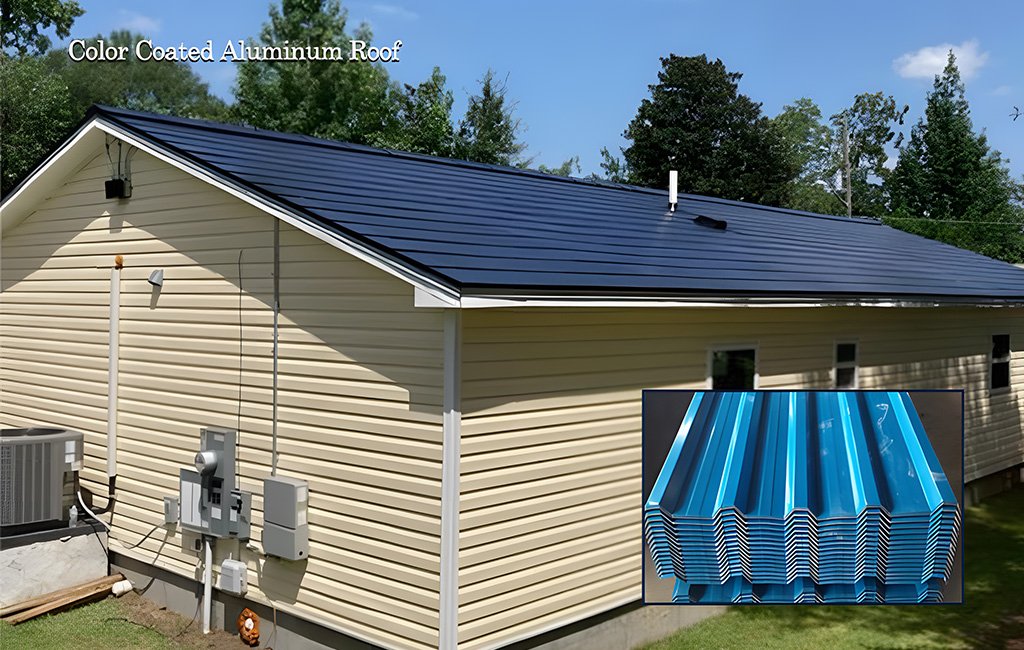
For global infrastructure projects, commercial curtain walls, and industrial roofing systems, the macroscopic impacts of unchecked substrate impurities manifest as clear structural and financial liabilities:
- Filiform Corrosion Propagation: Starting at exposed cut edges or fastening holes, corrosion propagates in thread-like filaments beneath the paint film. High iron concentrations increase filament growth rates up to 0.5 mm/day in humid coastal environments.
- Loss of Aesthetic Color Fastness: While color fading is primarily a UV-driven polymer issue, sub-coating oxidation caused by impurities causes uniform micro-blistering. This alters surface light reflectance, making the coating appear chalky or prematurely aged, dropping the color retention rate below 75% within 5 years.
- Failure to Meet Global Engineering Specifications: Substrates exceeding standard impurity thresholds fail AAMA 2605-20 criteria (which mandates minimal gloss loss and less than a $\Delta E = 5$ Hunter units color shift over 10 years of South Florida exposure testing), voiding architectural warranties.